Showing posts with label Mini Pedals. Show all posts

Thursday, January 12, 2017

Ugly Guitar Truth: BBE Mini Sonic Stomp

So, I've a complicated relationship with BBE's pedals. I had the Acousi Max... and I really liked it. That is until its power jack tore the trace off of the pcb and I had to perform surgery on to keep it working. However I was never really able to trust it after that, so I leaned more on my Aphex Acoustic Xciter pedal (great pedal btw). I've never really bothered with the regular Sonic Stomp/ Sonic Maximizer. Why? I've been able to recreate most of the effect with a decent EQ pedal. So, when I saw that BBE had made a mini version of the pedal, I got excited. I thought that maybe it is time to pick one of these up. I could save some space on my board and have a simple "tweak the highs and lowest" kind of pedal. And then I found some things that weren't so pretty.


Concentric Knobs


The first time I saw concentric knobs it was on the BOSS MT-2 Metal Zone. I thought it was a great way to offer more controls in a tight space. Super cool idea. But what I don't understand is what they decided to do it on this particular pedal. It has two controls. Even though it is in a tiny package, it still has room for two separate knobs. So, why make it more difficult to manipulate than it has to be. Doesn't make a lot of sense to me.


Pricing


Yes, I know, I'm cheap. $99 is fine for a great pedal. The Sonic Stomp is cool pedal. It's Super useable, simple and straightforward. But the regular version is actually cheaper. Right now the regular Sonic Stomp is under $65. Used you can find them for $40. So why are you going to pay nearly double for a mini version. Obviously BBE have their reasons for their pricing, but in the case of Ibanez, their mini pedals are priced under their full sized units. EHX also cuts price along with size in most of their pedals. So why BBE do you have to up charge are down sizing.


Conclusion


That's all I really have to say about this pedal. It is really simple, and probably just as good as its bigger brother. Maybe it is a full update to the hardware. They could have called it a MKII if that's true. To be honest, I would have minded if they stuck it in a 1590b sized box and kept the price were it is.


Support the blog by shopping on Amazon by using my link!


There should be an ad below:


Monday, February 22, 2016

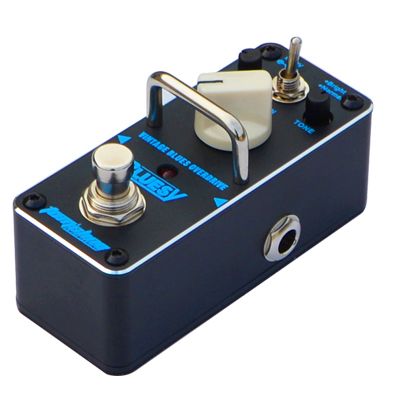
Ugly Truth: Tom's Line Engineering Bluesy Vintage Overdrive

Weeks ago, I decided to splurge on some music gear. I've always seen the cheap pedals from china, but I hate buying something and waiting weeks for it to show up (if it shows up at all). Not to mention the poor customer service and quality control. I decided to roll the dice on these guys, I was able to put together an order for four pedals, all drives (go figure...) When they showed up, they were in a box very similar to the Outlaw Effect's. Included was a somewhat helpful foldout user manual and a piece of Velcro. Overall, it was polished and professional looking. So the packaging exceeded my expectations...(woopty-doo). We don't care about boxes, (unless you're like me and keep all the boxes your pedals come in) what does it sound like?

Using a P-90 equipped Telecaster, I put this pedal through a Vox Pathfinder 10 combo. My bedroom setup is modest, but it sounds great for it's size. Putting this pedal inline was a joy. I really liked the sounds that this pedal put out. There isn't a ton of gain in this pedal, but that should not be a surprise since it's described as a blues overdrive. There is a range of tones that please just about anyone (looking for a light overdrive). After testing out this pedal, I was able to run it into a Vox AC15 with both a Standard Tele and Deluxe Telecaster. These combos resulted in please sounds. The 'normal' and 'bright' settings came in handy, One to tame the spanky single coils and the other to brighten the split-coils in the deluxe. Whether you are finding a bluesy voice for you solid state amp or your looking for something to boost your tube amp into sweet breakup, this pedal can serve up some nice sounds. Listen to Shnobel:

But were aren't here to talk about the pretty things, Let's get ugly:

Let's Get The Obvious Out Of The Way

It's Chinese, It's Cheap, It's Tiny. All these things are scary. The last time I ordered a pedal from China, it was DOA. Thankfully, all these pedal came in working condition. The price I paid is not my concern. In fact, I thought that the price I paid was great. But it's the fact that I was able to buy a pedal for so little that makes me wonder about the quality of the guts. Ignorant of the insides, I do like the sounds. However, I hate tiny pedals. Why did I buy so many of them... They're cheap, that's why. I will say, it was smart to put the bar to protect the knobs. I've always thought they were in danger from people with heavy feet.

And That's It

I know this seems very favorable, but I really can't come up with anything more to complain about. It's a light overdrive that is flexible. It's cheap enough to bought with the change from your couch. It's not the fanciest pedal. It's a simple pedal that could fit on nearly any pedal board. If you watch that video above and scroll down so that you can't see the pedal and just listen, then you might just fool yourself into digging the tones that Mr. Shnobel is putting out.

Conclusion

Having said all those nice things, I probably won't be putting this on my board. My dislike for this tiny pedals and the wide range of low-medium gain pedal that I already have make it hard to find use for yet another. What I might do is put together a small 'travel size' pedal board. It could be fun to go through these little cheap pedals and put the good ones together on a board. Then putting that board against my main board. Not so much to see which one is 'better', but if you can put together tiny pedal to do most of the job of a typical-size board fill with 'full-sized' pedals.

Thursday, March 19, 2015

The Ugly Truth About Joyo Pipebomb Compressor Pedal

If you've looked at any music gear website, or have been inside an actual music store within the last few years, you have probably noticed that pedals are getting smaller. Even the larger pedals that we see coming out are compact. Pedals like the Fuzz Face and Big Muff Pi are considered huge and bulky next to most of Boss' line, next to this new wave of ultra small effects, pedals like those are mammoth. Joyo has put out a line that is no longer than my thumb and not much wider. A pedal with a footprint that small is crazy. When looking for a compressor pedal for my already cramped board, I found these and thought that I'd give it a try. Comp isn't an effect that I use a lot, but is something I want on hand for when I do. I've had several compressors, but none of them have really filled that specific niche in my sound I'm looking for. The Visual Sound Rout 66 was a great OD slapped together with an OK comp. At least, the comp was just not what I was looking for. I've played the Boss CS-3 and found a vintage CS-2 that really didn't fit the bill. So I wanted something with a knob to blend wet and dry signal like some of the high dollar jobs, and I wanted it to have a small footprint to squeeze onto my board. So the Joyo fit the bill, as long as it did it's job in a manor of my liking. So here's what I found out:

Joyo has thought this through.

If you read about these pedals or watch videos on YouTube about pedals, then you might have seen that these pedals come in a nice box with some extra stuff. There is no rubber on the bottom of the pedal and the screws that hold the bottom plate on are countersunk so that the bottom is completely flat. In the box is a standard "anti-slip" 3M rubber mat and a precisely cut piece of Velcro. To me this means that Joyo totally gets that these pedal are meant to live on a board. If you lay all your pedals on the floor then you really don't need tiny pedals. The whole floor is your board! The knobs have a interesting cover to protect them from when your foot hits the switch. This is a nice touch considering the knobs are no larger around than a pencil. The stems on the pots must not be much larger than the lead of a pencil. I've seen regular pots get snapped off, so a wayward foot could probably do some damage.

The sounds are familiar.

To sum up this pedal you need two words: subtle and transparent. With the comp all the way up you notice the effect, but it's not really "in your face". In fact, that is one of my favorite positions. Although, I play with compression like it's an effect that is supposed to do something special instead of using it to "shape" my tone. For the most part, it is hard to tell when the pedal is on, but in a kind of good way. It doesn't color your sound or dampen your high-end. The pedal can be dialed in to let your clean signal in along side the compressed signal. This is a subtle pedal when its set to 100% wet signal. When you dial that back, it gets difficult to hear the effect at all. I know that I'm not an expert at compression pedals, but it seems like you should be able to tell when it is on.

It starts to get ugly.

So the pedal does what it says. Although, sometimes I find myself wanting to turn the knobs past their stopping points. That is until I start hearing the hiss that comes from this pedal. I put this pedal on my board for a set with the group I play with. I was excited to hear this pedal in the mix with a whole band. Everything was fine until someone said, "What's that hiss?". I was running through a Fender Blues Junior at stage levels. The hiss was more than a little annoying. I don't normally run into this problem so I don't have a noise gate on my board. That meant that the compressor had to either be dialed back, or turned off. The whole thing left me a little underwhelmed. I dialed the levels back and continued use until something developed a hum. It only stopped when I turned that Pipebomb off. That is the way it stayed until I had time to address the issue. The problem might have been something knocking the power jack around. It is located on the side of the pedal instead of the top of the pedal like most other pedals. Another black mark on the pedal is how it clips when in the signal path of a guitar with hot pickups. I played at many different levels and amps while trying to attribute the clipping to something else, but the only consistent thing was when running through a hot humbucker, this pedal acts like an OD. The sounds are not terrible. Actually it was a nice soft clip, but I couldn't get the signal to clean up. I turned the volume down, but it had to go way down to clean up. This was the biggest bummer of the entire review. I only got this effect when running a very hot humbucker. Other guitars did just fine. Strats with your average single coils really benefit from a little compression and had none of the clipping from my hotrodded Tele. This might be a common thing with compression in general, but it is a little underwhelming.

Is it worth it?

Joyo is an imported brand that has a reputation of copying other pedals and selling them at a value price. This doesn't seem to be the case with this pedal. Even if this is a copy of another compression pedal, the price isn't necessarily rock bottom. At nearly $70, its a sizable investment for a pedal with the reputation of being a budget brand. There are things that this pedal gets very right, and other things that miss the mark. Packaging and design are the selling points here, but the very subtle effect, odd placement of the power input, higher than average price tag, along with the downside of these ultra-compact pedal inherently have, the price might warrant looking elsewhere for a similar unit.