Showing posts with label review. Show all posts

Tuesday, September 26, 2017

Hands On Review Of Behringer EM-600 Echo Machine

If you are familiar with the Behringer line of guitar effect pedals, then you know that they are mostly BOSS clones. They are basically plastic versions of our favorite BOSS pedals. So what BOSS pedal is the EM-600 Echo Machine? It's actually a facsimile of a Line6 Echo Park. You may have know that. Actually, If you are reading a review for the EM-600 then you probably already knew that.  So, is the EM-600 a decent replica of a Echo Park? Let's see...


Old School


So, just like all the other pedals in this line. It is very similar to the size and shape and function of the BOSS format. However, that format is old. If you look at the pedals of twenty years ago, you'll see that a lot of companies made pedals just like that. DOD, Digitech, Ibanez, and others made pedals just like that. However, form and formats have changed over time. BOSS is huge and doesn't have to change, but inexpensive pedals attracts younger players and younger players follow trends. Those that want trendy pedalboards will have to weigh economy against style.


Where's It At?


Just in the past few weeks, this pedal has become hard to find. Most of the main online retailers have gone from 'item backordered' to 'no longer available'. You can still find this pedal on the used market, but there are few to be had and people are already asking more than street price. It may be easier to get a hold of an actual Echo Park.

The Sounds

So, this has been a pretty solid Ugly Truth post, but we have to talk about how the pedal actually sounds. This pedal have a ton of modes, but the ones that matter to me are the Taps, (quarters, eighths, and dotted eighths) Swell, Multi 1, Multi 2, and Reverse. The taps are super basic. I'm just stoked to have a tap tempo on a $50 delay pedal. Swell is a key feature of the Echo Park. It was a big deal when the pedal came out and its still cool to play with. The Multi (pattern delay) setting are really cool. I wish they were a little more flexible. Reverse is a pretty standard feature, but when you add all the feature together, then you have a deep mode selection for minimum cash. If that wasn't enough, you have a Analog and Tape filter. And you have Mod control. There is just a stupid amount of feature packed into this pedal. I wouldn't say that all the sounds are 100% convincing, but just the fact that they are there is impressive. It's close enough to fake it in a pinch.

There Is A Problem

There is always a problem. There problem with this pedal (other than the plastic construction, old format, an unoriginal design) is that with the mix knob is at 100% the bypass signal can completely drop out. I noticed this on the Swell setting. On the swell setting the mix knob works like a mix know rather than a effects level, so when it is at 100% then you have 0% dry signal. However, even when the pedal is in bypass mode the signal is lost.  So, if you are using the Swell feature, then you can kill your entire guitar signal. Unless... you turn the tails to off. So, there is a work around. But in that particular circumstance, it is a little annoying.

Conclusion


I've tried out a few delays lately. This is the only one that I've thought about adding to my board. It does some things that I can't do with my current delay (swell) and I'd like to have a number 2. If I did add it to my board it will probably be a place holder until I get one of those uber delays, then move my number 1 into my number 2 slot. That all said, this is a solid delay. I might even recommend it higher than a DD-6. When its half the price of any pedal that objectively beats it, and it can compete with any delay under a hundred dollars its hard to put it down. Check one out, if you can.


Wednesday, June 28, 2017

Ugly Guitar Truth: Boss MD-500 Modulation Effect Pedal

Along with the RV-500 Reverb and Katana Mini, Boss announced the MD-500 modulation pedal. It sport the same frame of the RV and DD 500 pedals, but it specializes in modulation effect such as Chorus, Flanger, Phaser, Classic Vibe, Vibrato, Tremolo, Dimension, Ring Mod, Rotary, Filter, Slicer and Overtone. If that seems like a huge list of various effects, it is. So is this unit a shiny new 10/10. Let's take a look at what we know and what we can gather.

Inspiration

I think that most of us know realise that the BOSS 500 series is heavily influenced by the Strymon line of effects. The Timeline, Big Sky, and Mobius are legendary in their own right and few choose to compete with them in the compact, powerful, dedicated, floor-based effect market. By no means do I mean that BOSS cloned the Mobius, but the format and function of the 500 series sync up with flagship Strymon pedals pretty well. BOSS has put their unique touch on all the pedals in this line. They've also put great thought into the features and effect that went into this pedal. Although it share some characteristics with the more established pedals, the MD-500 is a stand-out in its own right.

Something New, Something Old

This brand new pedal has a list of feature that stretches long. Included in those are some that are familiar with  those who know their BOSS pedals. The Slicer and Dimension effects hearken back to pedals of BOSS' past. Long loved effects that have found a home with those that desire eclectic, vintage tones and those that want unique, creative effects. Also available in this unit is an effects loop. Place it before or after the main effect, the loop can be set to be triggered by the Control/Tap foot switch. Don't let the simple layout of the pedal fool you, this pedal fully editable.

More Than Meets The Eye

On the surface you get a powerful modulation pedal, but that's just scratching the surface. Each effect is deeply editable through an LCD screen or by linking to a computer and using BOSS' effects editor. All of these features are packaged into an unassuming, attractive frame. What make this particular pedal special, is the fact that it does so many different effects. Where the DD-500 does delay and the RV-500 does reverb (and a little delay) this pedal does so much. It's hard to say that a ring mod and rotary effect are related, but there they are sharing space on the same pedal. That's where this pedal shines. Where you may not use tremolo on every song, you very well may find one of the many effects available in this unit that you do need. So where as the DD-500 might replace your delay and the RV-500 could replace you reverb, the MD-500 might well well take several pedals off you board.

Conclusion

The MD-500 is something that the market has been looking for. Does it complete kill the Mobius? It's hard to tell since the pedal is currently only in pre-sell. Personally I think that the Mobius is a little more exhaustive. However, the MD-500 is offering a lot and the price seems like a bargain compared to similar units from Strymon and Eventide. It will be very interesting to see how this pedal stacks up with established top dogs in this section of the market.


Support the blog by shopping on Amazon by using my link!


There should be an ad below:


Thursday, February 9, 2017

Ugly Guitar Truth: EHX Canyon Delay/Looper

This little pedal flew completely under my radar. I paid attention to all the NAMM 2017 debuts but somehow didn't even get a hint of this pedal. Tell me if I'm wrong, but did you see anything about this pedal before now? Regardless, here it is, and we have to talk about it. Thankfully this pedal should drop on the 13th of February (2017) so there isn't much waiting for this one. As for price, well, there seems to be a little confliction as to what can be found online. Musicians Friends had posted a price tag of 158 USD, but EHX has been caught tweet a cost of 139 USD street price. So with the information that we have, Is this pedal a yay, or a nay. It's mighty morphing Ugly Truth Time...


It's Small...


Alright, small can be a good thing. Lots of good things come in small packages, but delays that occupy tiny spaces are usually lacking in the feature department. I mean, look at the Strymon and Eventide well-endowed delay boxes. Those are feature packed and massive. So this little box couldn't have that much to offer... Except it kind of does. 11 modes give you more than a BOSS DD-20. It can loop for a full minute and you get 2 "secret knobs when you hold the Tap/Divide button. This has to be one of the most feature laden delays in the size box. No, it isn't stereo. But you can control the rate and depth of the modulations. Correct me if I'm wrong, but that's a new trick for a compact delay.


Don't EHX Have A Lot Of Other Delays?


Yes. Yes, they do. The Memory Man/Boy/Toy line is extensive. And they do have some cross over as far as price. There is even a DMM (Deluxe Memory Man) setting on this pedal. However, this is a digital pedal. Kind of different for EHX, but I guess they were just waiting until they really had something that they liked before they put one out. Analog Delay users are going to analog, digital are gonna digital, that's just what happens. What has a lot of people looking at this pedal is the long list of modes and the affordable price. It could also be the neat tricks that this pedal is capable of that has people interest as well.. hmm, guess there is a few thing to like about it...


Wasn't There Another 3 Second Delay Released Recently?


Yes. I even wrote my thought on the DOD Rubberneck here. I like the DOD delay a lot. It has a lot of cool things going for it. It also has a $250 Street price, so fair is fair. The DOD pedal has features that this pedal can't touch. The titular feature, Rubbernecking, is pretty unique to that pedal. It also has a built in tap feature. Admittedly, the DOD looks cooler. But If I had to go with one delay on my board and also had to choose between these two pedals, then I would be picking the Canyon. The Rubberneck is a pedal that I'd be proud to own, but if I had to choose one, then I'd pick the one that can Loop, Reverse, Shim, Octave and Verb.

Conclusion


I like this pedal. I like this pedal a lot. You could probably tell that already. This pedal would be a great addition to a pedal board that wasn't already fitted with a delay. I'd even pick this one over the BOSS DD7 and the smaller Flashback delay. If you are looking to upgrade your delay but don't want to get one of the larger "do everything" units or if you looking to save a buck, then this pedal would be something to look at seriously. Should you drop everything and get this pedal for its wonderfully healing properties? Of course. But try to remember that this people isn't as powerful as one those others that have all the blinking lights and MIDI and extra holes... Oh, it has a dumb name too...


Support the blog by shopping on Amazon by using my link!


There should be an ad below:


Friday, January 27, 2017

Ugly Truth: Fox Pedals


I loved watching NAMM coverage this year. Seems like attendance is hardly necessary any more. All the cool new gadgets are getting shown off and I have to do is click some buttons and enjoy other pedal walking around and doing all the work. Also, if I were there, I'd probably have to play the guitar at the booths and I'm sure by the third day, no one will want to hear me play 'Back In Black' any more. Sadly, it seems to be the only song that comes to mind when I'm put on the spot to play something 'cool'.

Story time over, I've personally discovered Fox Pedals while viewing NAMM stuff, and I have to say that they absolutely are stunning. Some of their pedals look like something out of a Eric Carle book and others just have pretty graphics that seem to graphic describe the sounds made with the pedal. So, they are an emerging pedal maker and they look great. Is that, like, it?

Yeah, Kinda

I don't know a lot about the company, I do know that they make a range of pedals, The most impressive one being The Wave. It is a delay that does various washy, trippy, and unique sounds that really don't seem to be easily duplicated by other pedals out there. Their Kingdom pedal is a transparent overdrive that can crank up into almost fuzzy tones when pushed. (how's that for range) They showed off a fuzz, the Defector. The name and tones give me Russian Big Muff vibes, but I'm sure the pedal holds cool features.

Conclusion

Really, this whole post is one big conclusion. These pedals are very interesting. They are boutique and have the advantage of being able to push boundaries in ways that larger companies really can't. It looks like these guys have some great ideas and I'd like to see more from them. Really cool stuff. 


Support the blog by shopping on Amazon by using my link!


There should be an ad below:


Ugly Guitar Truth About Pedal Board Amps

Diffidently not a new thing, but a huge trend this year at NAMM, the pedal board amp has seen a huge rise in popularity among manufactures. Seymour Duncan, among others, have put forth product that are designed to basically take the place of the power section of your amp. Vox has put out a tiny amp head that would be easy enough to mount on a board. Hotone has designed a 20 watt head that is to be paired with their amp model pedals to create a varity of tones. A conglomerit of boutique amp called Boutique Amps, have devised a system of enterchangable preamp circuits to recreate a range of... boutique amps. What does all of this have in common? Not very much, I kind of went off the rails there a little bit. What I want to talk about is that we are seeing tiny little power amps flood the market and what that fact means for the world of guitar players. Shall we?


First Things First


Guitar player hate change, or we love it depending on who you ask. I can't wait to see what pedal or piece of kit come out next. Then I plug my Telecaster directly into a Vox AC15... Loopers, Delays, pretty much everything Strymon does, has facilitated progression in the guitarist spectrum. However, we still love playing amps that were designed in the 1950s with antiquated technology. We can plug a pedal into a Blues Jr. to make it sounds like a space ship taking off and then talk about the richness and warmth that you value from that amp (to make space noises with).


Then Something Happens


Something that the average guitarist has is pedals. Collect a few of those, and you get a pedal board. The most common pedals, or the ones that seem to pile up, are drive pedals. The ones that give you a boost or gain can really help your amp be all that it can be. In fact, so pedals emulate completely different amps. Pedals like the 30 Something, or Golden Plexi practically tell you, "This is a Vox sound," or "This pedal sounds like a Marshall." So if your pedal sounds like an amp, what is your amp doing.


What Are We Doing?


On my board there are several pedal that handle Gain, EQ, Reverb... so I set my amp clean, flat and kill any reverb. If I set my amp to a nice tone (not hard) I will be finding it difficult to find a application other than simple signal processing for my pedals. However, set my amp flat, and I can use my pedals to create a wider range or tones leaning more heavily on the pedals to come up with the distinct sounds. What I'm saying is: you can have a range of great sounds from a particular amp, but they are going to sound like that amp, but a flat (pedal friendly) power section can give you more room to let you pedals shine through.


Conclusion


I meant to talk about amps like the one Seymour Duncan are putting out, but looks like I've just chased my tail for 500 words. Long story... still long actually... pedals are covering a multitude of tasks. Some of those tasks have long been associated with guitar amplifiers. As we are doing more signal processing before the amp, we are asking less of the actual amp. Thus, we are seeing amps that compliment this by having few features and simply push our tone into a speaker. I like this, and at the same time, I don't really like this.


Support the blog by shopping on Amazon by using my link!


There should be an ad below:


Thursday, January 26, 2017

Ugly Guitar Truth: DigiTech FREQOUT


When I first saw this pedal I really didn't know what it was. I saw the large letters that spoke to me somehow. "Freak Out" is the not only the name of the pedal, but also what I did when I realized what this did. It is a Feedback Creator. Strangely, Digitech forgot that BOSS has already made a pedal that did this. Not only that, but they also forgot that no one actually bought that pedal. So why have they chosen to make a new pedal that has already failed? Well, the truth is something we should see about...


It Isn't A BOSS Feedbacker


My knee-jerk reaction was that this pedal was simply a second attempt at an old concept. However, as the booth-guy at NAMM this winter explained, this pedal actually does something that hasn't been done before. This pedal is able to produce natural feedback at any volume. I'm not sure what the BOSS pedal did (if not that) but we will assume it was unnatural for the sake of argument. This pedal has an indicator to tell you how much feedback you have. (also not sure why you need this. your ears should do the same function rather well...) You also have adjustable Range and Type. I'm sure they do something important, but I can't tell you. DigiTech's official website doesn't mention what they do at all either, so I guess we'll have to try one and see...


Conclusion


I like feedback in some applications. I think that this pedal has a lot to offer in the 'make noises that don't sound like guitar' category. I even like the look of it. Digitech is putting out pedals that seem to expand on the sounds that their line of pedal can make. This is actually rather refreshing. Some pedal brands seem to find endless way to make the same drive pedals, but only slightly different. And then continue to make slightly different pedal till the end of time. This seems like a fresh approach and I like what I've seem of this pedal so far. Is it for me? Hard to say. It might be something to keep my eye on though.

Wednesday, January 18, 2017

Ugly Guitar Truth: EHX Blurst Moddulated Filter

EHX has once again put a new and rather innovative product to market. They call it the Blurst and describe it as a Moddulated Filter. While that sounds like it makes sense, I don't recall anyone really talking about the limitations or features of their prized modulated filter. It seems like a oddity or niche type of effect. I decided to take a closer look at what this pedal does and see if there is any reason to get excited about this pedal.


You Don't Need(?) It

Yeah, this thing makes some weird noises. These noises are not what you typically think of when you imagine guitar noises. But that could be fun, right? Sure. There isn't a lot of information or demonstration out there right now. But, from what we can hear on the EHX demo video, it sounds like a synth filter. However, the interesting part of this filter is that it is time based rather that controlled by your guitar input. You can choose your wave form, tempo, and mix. I feel like there is a lot of versatility with this pedal, but the video only gives us a glimps at what it can do.


Its Strengths Are Its Subtleties

If you watch the demo then you hear a whole lot of 'bwwaaaahhhh' types sounds. To be honest, I don't see much use for these noises. I understand that there are types of players that can make some great sounds with filters, but typically don't use them or just use them in a very limited capacity. However, at the end of EHX's demo, they stick the Blurst in the effects loop of a Deluxe Memory Man and it's actually pretty epic. Plus, I have to give honorable mention to the sounds in the video made with help of EHX's 8-Step Program (stepping expression controller) which give you a step filter/seek wah/FM4 type sound. These two pedal can create lots of combinations, but seems like a lot hardware to create an effect done by a single pedal (just my 2 cents).


Conclusion

Look, I want to like this pedal. It looks... interesting. It has lots of knobs and buttons. It makes weird sounds, but maybe I'm just thinking to much like a guitar player. I want to be able to riff and jam, and this things seems like a noise maker. So let me completely contradict myself. The couple of sounds that I did like, were actually pretty cool. Plus the one thing that make this pedal different is what really makes this pedal. The tap feature allows you to sync up with the tempo of the music being played. I'm not the biggest fan of filters, but I'm not aware of many that let you do this. Can you make to sounds in the demo with other pedals? probably, but is a rather versatile pedal with expressive features.


Support the blog by shopping on Amazon by using my link!


There should be an ad below:


Monday, January 9, 2017

Ugly Guitar Truth: Marsall Code vs Boss Katana

Recently I was able to check out two of the most promising budget/modeling combo amps released in 2016. The BOSS Katana (100 watt combo) and the Marshall CODE (50 watt combo). Both of these amps have been backordered and hard to come by via the online stores practically ever since their respective releases. (The Marshall CODE, as of this writing, is still backordered) So when I was able to sit down and meet these amps in person, I was very excited. I had been cautiously excited about these two from the moment I saw there specs. I was eager to find out if they would exceed my expectations, or succumb to the fate of most other modeling combos. Let's find out.


The Marshall CODE


I was very surprised by the size of it. It was so tiny. I had to reassure myself that I was actually playing the 50 version and not the 25 watt 1x10. I was, and boy could I tell. It was loud! I had a fear that it would sound boxy, it didn't. The small frame is very misleading in the best way possible. The next thing I noticed was the controls. I should say, the lock there of. I've seen plenty of pictures and I knew the specs, but nothing really prepared me for the simplicity of the layout. I recalled using a Marshall AVT 150 head with it's 24 knobs. I absolutely loved this about the CODE. It is very easy to tweak all the things that matter and there isn't any messing around with menus unless you absolutely have to. Although, if you do want to fiddle with presets, you (kind of) have to download the app. These amps do suffer from what all modeling amps suffer from, endless menus. From just a little poking around I was lost and then greeted with ear-blistering feedback. I must have pushed the wrong button. There are 8 of them, and each one made me feel dumber than the last. But that's why Mashall made these amp Bluetooth ready. Now we have a pretty little app to navigate instead of fidgeting
with all those buttons.


So I was somewhat limited to the preset to my review, and I am aware that the "presets always suck", but then there's the Marshall CODE. The preset are actually pretty good. They also span a good range. They aren't just: Metal, Nu-Metal, Grind Core, Heavy Metal, Metal-Metal.. and so on. Everything from cleans to crunch, and yes, even metal where offered up and surprisingly believable. Understand I come from the dark ages where modeling amps just gave you a range of eww to yuck. You desperately tried to clean up to tone enough to keep it from becoming mushy and falling out of the mix. But this amp would have no problem with that. It has plenty of presence, and it holds its bottom end quite well. The single most impressive thing, to me anyway, is the freaking cab simulator. I might as well hang up my gear review career (bahaha career... anyways) because I never saw the day I'd actually like a cab sim, but this one works. It's not just different colored blanket over the speaker. I don't know what wizard they have at Marshall casting these spells, but these thing made this tiny little amp sound like it came from my Marshall 1960 cab. Huge caveat: the amp most diffidently has an optimal listen position. Please don't think that you can fill a room with this amp like  you could with a 4x12, but listening from the right spot, you absolute get the feeling that you are playing through more than one speaker. Guys, I kid you not, after I played this amp I didn't know who I was any more. I had a full existential crisis. It got weird. Things that I believed were falling down all around me. Who was I? Why was I there? And then I remembered that I was guitarist and I was here to rock! On to the Katana


The BOSS Katana


Still a little shaken from playing the Marshall CODE I started on the BOSS Katana. For a hundred watts, this amp is on the small side. It would win in a bar fight against the Marshall 50 watt CODE, but it'd be beat up pretty good. (assuming the Mashall 100 watt 2x12 CODE doesn't show up... that guy... ptsh) The Katana rocks a 12" speaker and cute little kickstand. Even on the .5 watt mode this amp was plenty loud for the room. However, I didn't want to listen to an amp whisper at me, so I turned it up to the 50 watt setting and adjusted everything to my liking. Including the power mode selector, the Katana had a dozen knobs. My heart sank. I loved being presented with the Marshall's simple-six, but BOSS was smart and organized them in way that even made sense to me. In addition, I found the BOSS, predictably, more flexible (by hand) than the Marshall. changing things like effects on the fly were much simpler with the BOSS. However, the real magic in the amp is in the flexibility and maneuverability of the Tone Studio editor. It's basically like unlocking the cheat codes to a video game. There is so much more if you really want to crack into it.
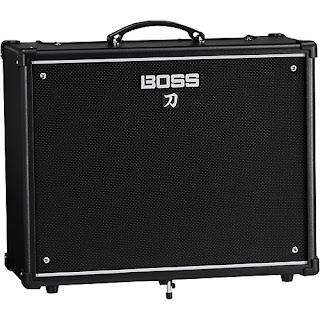


The greatest strength of this amp is the Amp Type selector. There are only four modes (excluding the acoustic mode) but every one of them is usable. In fact, actually rather stellar. Each one sounds natural and clear. Unlike other amps that just heap mud on top of your tone as you travel gainy to gainier amp settings (looking at you line6). BOSS has done a very smart job of making each type distinct and nuanced. The Lead setting isn't Crunch but louder, The Brown setting isn't lead but... brown-er? Anyways, each setting is lovely. You can hear the years of experience in this amp. The Clean and Crunch setting borrow form Roland's Blues Cube, and the Brown setting is the little brother of the WAZA Craft amps. Not having any experience with the included software, I can't speak to its usability, however it looks like you have the flexibility to nail a huge range of tones. These are lovely little amps that seriously rocks. However, they do lack the mobile app interface. Something I, until recently, assumed they had (woops). Besides that huge, glaring misstep, this amp is a homerun. I was much more excited than I had any right to be for this amplifier, and I was not disappointed.


But this was a verses review...


Conclusion


I'd almost have to pro/con this one out. Marshall absolutely killed everything. BOSS put together something that was everything I didn't know I wanted. Marshall has a deeper set of parameters. The BOSS does everything very well, and has some features that the Marshall doesn't (line in/out). That is kind of unheard of in amp in this range. I think BOSS thought that people are still going to want to run effects into their amp and having that option helps a ton. That way you don't run all your outboard effect through that digital modification. That's smart. Marshall is basically a do it all box that could possible have software updates making it virtually limitless... kind of scary... in a good way.


So I played these amps back to back. I had no idea which was better when I was done. I didn't know which one I'd choose when I started writing this (full disclosure: I was leaning BOSS). But after having to write about the Marshall and really process all that information again, it is really close. Real talk, it would depend on the situation and your preference. For me? I'm going with the Marshall.


Why?

  • Super Flexible
  • Amazing Amp Sims
  • App integration w/Bluetooth
  • 5-At-Once Effects
p.s.


I know this thing is super long and thank you for reading this far, but let me know if you guys like the whole "verses" thing or if you like your review to be more standalone. The situation kinda presented its self in a head to head way, so that's what I wrote. Anywho... Thanks!


Friday, June 24, 2016

Ugly Truth: Boss TU-3W Waza Tuner

Yaaaaaaaaaaaaaaaaaaaaaaaaaawn...


This whole post could be a rant about how boring tuner reviews are, but I'll try to stay on point here. Boss has put out a new series of tuners. The chief among these is the Waza Tuner. If you aren't familiar with Boss and/or their Waza line, just know that Waza means you're going to pay more. As with the other Waza pedals, you really aren't getting a whole lot more for your money. Basically, Waza pedals give you two things: final quality control in Japan and a switch that lets you select from stock or mod. In this case, the mod is true bypass. That's it. You can turn your TU-3 to true bypass. That and they painted it black, so watch out, this pedal had an attitude...


And Then you Have The All New TU-3S (see the pattern here).


It's almost as small as it is not-exciting. I don't know about you, but one of the important features of the Boss pedal tuners was the fact they could mute your signal. This let you tune silently, and doubled as a panic button for when you rig has a ghost and starts to make all sorts of horrible noise. But don't worry, this tuner did away with all that functionality. And it can be yours for only the exact price of the actual pedal (the one with all the features still intact). I wish I was kidding. It is rather smaller, but not any slimmer. Last time I checked, the width of the pedal had more effect on pedal board real estate. I guess someone thought this was a good idea...


A Clip On Tuner


All kidding aside, this one is actually pretty solid. I've gone through the list with clip-on tuners. Some are better than others, but most are just barely passable. Boss have a pretty great track record when it come to tuners, so when they put their name on one, that carries some weight. This one comes in at less than $20, so it is still affordable and I wont cry to much when I eventually lose it.


Going Old-School


The last new tuner from Boss is the TU-30. Its a little more old school, and it gear toward more than guitarist. It come with a metronome and loads of extra features. If you want to read the full list of the features visit Boss. This one is probably the least excite of the four. However it does remind me of the days when I first learned the guitar and when I used a Korg tuner. That thing never stayed put and made tuning a bit of a hassle. I also lost probable a hundred dollars worth of then before switching to floor based models. I'm sure that the tuning and metronome feature are solid and that these would make great classroom and practice aids.


Conclusion:


sooooooo boring........

Friday, April 8, 2016

Vox AV Series: Update

I first reported about these amps when Vox announced them back at NAMM this year. They Stood out because of there styling and features. They are analog, solid powered combos that look rather striking. The looks alone were enough to make me interested. I've been able to see one in action and I have to say that I'm am impressed. I was almost dismissive of the new line. I wasn't the biggest fan of the little modeling amps that came out recently. I was afraid that these guys were still coming from that prospective. This does not seem to be the case. These are something akin to the Super Champs that Fender put out. They replicate the front ends of other various amps, sans digital modeling.

Starting at just over $200 these amps are poised to be an excelent first amp, or a great step into valve-ish amps. If you need or want a variety of amp sounds but don't have the funds to buy half a dozen or more amps to make those sounds, then this amp could be an excellent fit. I liked the Super Champ amps and these seem to be in the same ballpark. In fact, I'd pick up one of these on the looks alone. The fact that these amps can emulate so many others and even the biggest one in the lineup comes in under $500 doesn't hurt either. Vox has put a lot of work into making great little amps. Even the the cabinet design is made to make you forget that (unless you have the 60 watt version) you aren't playing though a 12" speaker.

All in all. these amps are stacking up to be a step above what I was predicting. Kind of a foot-in-mouth moment, but I'm glad it is. The world need more great amps. This quite possibly, could be one. At least, it might be a good choice for many musicians.


Support the blog by shopping on Amazon by using my link!


There should be an ad below:


Wednesday, March 23, 2016

Ugly Truth About The Eletro Harmonix MEL-9 Mellotron Emulator

So Mike Matthews and company have been at it again. Offering us yet another pedal that we didn't even know that we wanted, EHX have served us a new polyphonic pedal that emulates... Mel... Gibson? Wait, that can't be right...


That's Right, It's a Mellotron Emulator... Whats a Mellotron?

Not only is this a pedal that we didn't know that we wanted, it is a pedal that emulates something that we don't know what is. The description provided by EHX never says "mellotron" outright. I'm guessing that it is trademarked by its makers. So, the suggest it. A mellotron, as I have recently learned was a type of keyboard that reproduced different voices by looping sample that have been recorded to tape or disks. So no one knows what a mellotron is, so why emulate it? Turns out that the sounds of this antiquated beast have been used by bands such as Genesis, Beatles and The Grateful Dead. Chances are, you've heard one of the those bands, or you may even like these bands. More importantly, bands around the country, and probably the world, are paid good money to cover these bands, so now guitarist are able to emulate the actually instrument played rather than play the riff while sounding like a guitar...

Another 9 Voices

If you have followed EHX's theme with these pedals, There are 9 voices in each box, this isn't surprising. It is a little frustrating. At this point, it's like buying a keyboard with 9 voices only for another keyboard to come out 6 months later with another 9 voices. The hardware in the pedals are staying the same. It's the software that gets the revamp. Why can't we shove a few more one and zeros in there to hook us up with a few more voices, or all the voices, or let us edit and create the voices... Come on Mike.

There Is A Pattern Here

It now seems like there is going to be a "9" pedal every 6 months or so for the rest of our lives. As long as we keep plopping down $200 for these things. Electro Harmonix is going to keep selling them to us. I'd love to see something like TC Electronics' Toneprint tech in EHX's polyphonic emulators. Let us edit and customize the 9 voices that we get to play with.

In Conclusion

I was impressed with the video that EHX released with this pedal. They have the promotion for these pedals really nailed. Show someone playing the pedal and make it sound great. If you make it recreate an iconic lick 'spot-on' then that's a bonus... There are several sounds in this pedal that sound great on the video. The Choir voices are pretty stellar. Also, I was impressed with the last little bit of the video where they strummed a acoustic guitar and made a guitar+fill sound. Making this a pedal that has a range of applications other than 'make you guitar sound like ________".


Support the blog by shopping on Amazon by using my link!


There should be an ad below:


Tuesday, March 8, 2016

Ugly Truth: Fulltone Catalyst

Lately I noticed that a couple of the Fulltone pedals have been marked down to a reasonable price. $80 for a Fulltone pedal used to be unheard of. The Catalyst and Fat Boost have both been marked to a discount price. I don't keep tabs on Fulltone, so I don't know when this happened, but everything looks like it has been recently. Used prices are still floating around previous levels. I was reading about the Catalyst on some forums and found where someone was over the moon to find one used for $99. I had a little experiences with the pedal a few years ago. I was playing some sessions with a group of guys, and used some borrowed gear. I dug the pedal then, but it was traded/sold. I haven't thought much about the pedal since, but when I saw that it was so affordable I decided to visit it again.

It's Flexible

You read the description on the Fulltone website and it makes this pedal sound like it can do anything. Boost, Overdrive, Distortion, and Fuzz. There are tons of pedal that want to do "everything" but few actually do more than one thing very well. Once you start to play with this pedal, you notice that it achieves several sounds. You might not like all of them, but there is probably a few you might. I ran this into my Vox AC15. It wasn't magic right away. I am a pretty big fan of the Vox on its own, but I did like the Catalyst as a Boost/light OD. It thickened up the sound and acted like a nice EQ. It sounded nice with Chords, but I think this pedal is more flexible than articulate.

It's Underwhelming. 

For a pedal that debuted well over $100, it kinda under-preform. This pedals actually acts better when the front of the pedal is hit pretty hard. I put a Klone in front of this pedal and it really opened up. This pedal seems to have plenty of head room, which is odd for a dirt box. So I'm guessing that it's a holdover from it being capable of a clean boost. However the boost isn't very "clean". It colors the tone in a very noticeable way. I liked it with my Vox. But I found that heavier gain setting were better with my American voiced amp.

I Like It

But I don't love it. It comes up a little short of awesome. My biggest complaint is that is not articulate enough. Chords sound thick and rich, but the single note runs don't translate well. Also, picking patterns get muddy. That's my biggest complaint, but you don't buy a fuzz to be clean and clear. But you think that your fuzz could be a boost, or work as and overdrive... So maybe Fulltone didn't really hit it out of the park with this one.

Conclusion

Fulltone may be clearing out the Catalyst and Fat Boost. They aren't the most popular pedals. They haven't been updated. Mine still say V1 on the PCB. This pedal is a little confused, but it still has a some good sounds. Its flexibility and versatility are what set this pedal apart. Would it be better if you had single pedals that did fantastic jobs of each one of the things that this pedal can do? Of course. However, this pedal is enough to do several different functions, and it has a voice that is unique. If you considered picking one of these up, then it may be time to grab one.


Support the blog by shopping on Amazon by using my link!


There should be an ad below:


Wednesday, February 17, 2016

Ugly Truth About Tone City King of Blues


If you suffer from GAS as I do, then you are probably aware of the influx of pedals from china. I'm not talking about BOSS, or Digitech, or Mooer, or Mod Tone or any of the other pedal brands that manufacture overseas. As I remember, it started with Joyo. They made a brand for themselves by mostly copying other pedals and rebranding them, all at discount prices. There has been several others to come about. These pedals have a bit of a stigma already. The first time I ordered a Joyo pedal, the wrong pedal came, and customer service was so bad that I opted to sell the pedal outright instead of returning it. There has been several brands to come about since, and service and quality seem to be improving as well. However Tone City don't seem to be turning out the 'same old stuff' as these other brands. When I first saw their pedals, I did think they were just shined up Chinese copies. To start, you can find lists of the pedals that most of their micro-pedal like is emulating. What caught my attention was their release of their larger, seemingly more original, pedals. I learned of these when I saw my favorite two Brits fool around with them:

Chappers and The Captain are amusing to watch and their production quality is nearly unmatched on YouTube. Something that you have to remember is that they are representing a store. This store sells the products that they are demonstrating. Bare in mind that it would not be beneficial for them to complain about or criticize these pedals. They are going to speak favorably about them, but one thing that Lee 'The Captain' Anderton said made my ears perk up. Most of these dual button Tone City pedals are voiced like very particular amps. All except one, one is just called, "King of Blues". Lee mentioned that he thought that it could be a aNaLoG MaN King of Tone clone. I decided to find out for myself.

I Haven't Played A King of Tone

So this first one is telling on myself. I haven't had a chance to play through one of the more iconic boutique pedals. I have listened to many high quality demonstrations, but I know that there is a lot missing from these. There is no way of sensing the attack sensitivity or feeling how the pedal reacts with the amp. I will say that I've heard a wide range of tone from this one pedal. Obviously the amp these pedal being played through are very important, also the guitar and anything else that is in-line with the pedal. So everything taken with a grain of salt, the KOT is a full sounding flexible overdrive. It is capable of clean-ish 'transparent' boost and thick saturated overdrive. So I may not have played one of these pedals, but I've spent a lot of time researching just what makes this pedal so sought after.

The Pedal Has A Mix Message

Several descriptions of this pedal include that the first stage of this pedal is a straight Klon copy. Stating the the second stage is an 'original' design. I find this a little over simplified. I also think that this description is a little lazy. However, you can't dismiss it entirely. Tone City makes a spot on Klon copy in the 'Bad Horse' pedal. The famous circuit shrunk down just like the Tumnus from Wampler. This is completely likely, however, the KOT and the Klon have similar features as it stands, so the comparisons between each of these pedals may not be totally baseless. I've recently put the King of Blues pedal against every Klon circuit I could get my hands on, and my verdict is that it may share characteristics, I can't say that its a direct copy of the Klon. For one, the Tone knob works like a tone knob (low pass filter) rather than a treble boost. The amounts of gain are similar but the output from the pedal is notably less. The King of Blues of much warmer than any Klon or Klone that I've ever played. From what I've heard of the Tone City 'Bad Horse' (klone) these are not the same circuits.

If It Is A KOT Clone, Then I Have Bad News

Let's say that this is a KOT copy. The real deal goes for north of $300. That's three times the price I paid for this pedal. That's KTR money. Sure, there are other pedals that fetch that kind of money, but what is really striking is that the pedal is only so-so. I do like the pedal. It is capable of several good sounds, and it is really flexible. Two 'channels' make it a great option to handle your overdrive tones. But, if this is a actuate copy of the famous pedal, then I don't see what is so great about it. I'm able to do everything this pedal does with a couple of other overdrives already on my board. This might have had the appeal at the beginning of the boutique boom, but now it's just riding the way of hype from its glory days.

Conclusion

This is a fine pedal. If you are looking for a multi-stage low/medium gain overdrive then this might be the thing for you. I'd put it above a Fulltone Fulldrive (a pedal that I don't really care for all that much), but I'm probably not going to replace what I already have on my board with this. There might be certain situations that I'd prefer this pedal to others, like if I wanted to run a small-ish board for some running around, but it fall short of the litany of pedals that occupy my board. Its good, but it's not "sell all your pedals now and get one of these" good.


Support the blog by shopping on Amazon by using my link!


There should be an ad below:


Friday, October 16, 2015

Is The KLON The New Tube Screamer?

Most of us that have peered behind the curtain of our guitar effects have noticed a trend that seems as old as the electric guitar (and its little effects buddies). People have been 'cloning' gear before 'cloning' was even a thing. Before the commercial success of the electronic effects industry, guitarist have been emulating one another in a myriad of ways. In the time before solid-bodied electric guitars, modified arch top guitars plugged into amplifiers were stuff full of rags to eliminate feed back. Amplifiers were modified with 'master' volume knobs to push the unit into situation. Beer bottles were used to emulate the sounds of a African folk instrument call the 'diddly bow'. These ideas were popularized and improved upon. We now owe solid-body guitars, overdrive and slide guitar to these trends. As we think back to a time when the lowly Tube Screamer was introduced, before the host of modifications were made common. One of the greatest guitarist famously used the Tube Screamer to shape his legendary sound. Fast forward thirty years and we see the trend again, only with a new name.


The Klon has an epic back story. Back in the mid 90s Bill Finnegan built the first Klon Centaurs. From there the popularity and mythos behind the pedal blossomed. Many popular players picked up on the pedals lure. The used value of the pedal skyrocketed when production of the centaur stopped. In the following years Bill, in partnership with others, developed the KTR to have the same effect while using surface mounted components. The trajectory of the klon follows that of the Tube Screamer. If we apply the same logic, what does this mean for the Klon? Well, if history serves: clones, mods, and and reissues.

Clones... There are tonnes of clone of the Centaur. A list would be academic, but makers have been producing these since the original has gone out of production. The replications haven't stop since the introduction of the KTR either. Wampler just released the Tumnus which puts the Centaur in a tiny package. Mods are common as well. The originals are still too sacred to tamper with (they are also covered in epoxy). But many mods have become popular for the clones and facsimiles. Reissues my just be an inevitability. At the moment, Finnegan seems unmotivated to produce any more Centaurs in any large amounts.

Tuesday, October 13, 2015

Is The Electro Harmonix Key9 A Disappointment

The other day, I was able to sit down with the Electro Harmonix Key9 Keyboard Modulator pedal. It was exciting. This is probably one of the most anticipated pedals of 2015. I know that there isn't a shortage of media out there about this pedal, but my experience was a little surprising.

The Sounds

Let me begin with the B9 and C9. These two pedals do similar functions. They both make you guitar sound like different type of organs. Piano sounds seem closely related to organs, so the Key9 seems almost a shoe-in for EHX. However, The two instruments are vastly different, thus the Key9 and the B9/C9 must make very different sounds. And they do. In my own head, I expect to be immersed in the polyphonic tones of keyboard when I plugged into this pedal, however when I ran the pedal 100% it still produced guitar like sounds. To be honest, I'm not extremely familiar with all the instrument the Key9 emulates. In my opinion the best sound the pedal made were the ones that were ones most different than the guitar. Steel Drums and Vibe were my favorites. They were convincing and a lot of fun to play.

The Disappointment

The Rhoads. I wanted this pedal for one reason. The suitcase setting was supposed to reproduce the famous Fender Rhodes suitcase piano. The demo EHX put out was a little underwhelming when it came to this setting. The flanger that is included on the setting is a little off putting as well. Even at the lowest setting it was a little too much. (of course the knob is there for 'speed' and not depth or mix so it's a little hard to tame in that respect) My biggest gripe is that this setting and others weren't far enough away from the guitar that originated the signal.

WHY?!

Yes, why is this pedal the luke-warm brother to the two coolest pedals in recent years? I have a prospective answer. Where as the organ is typically played by air moving through pipes, or some approximation of this, the piano is a string instrument. Yes, its played with a keyboard, just like an organ, but the sounds are derived just like a guitar. The Key9 emulates electric pianos, but the electric pianos were the 80's answer to acoustic pianos. So in reality the Key9 tries to sound like something trying to sound like a piano. It's modulation inception!

In Conclusion

I probably won't be buying this pedal. Even though I loved the concept. I was rather disappointed by the sounds. Maybe I had to much expectation going into this. I really wanted to be blow away by how authentic the sounds were, just like when I played the B9 and C9. However I was left turning knobs trying to coax a little more piano out of the box. I'll keep my eye out for some videos and or posts with hints to maybe get some more realistic tones and maybe revist this one, but right now it is proving to be a substantial let down.

Tuesday, June 9, 2015

The Ugly Truth About The Hardwire DL-8 Delay Looper


In search of a possible alternative to my trusty DD-20 Delay from Boss, I sat down with the Hardwire DL-8 Delay/Looper. In many repects the Hardwire pedal is the equal to any from the boss line. Offering a load of useful features, that you can read in full detail elsewhere, The DL-8 closely aligns its self to the Boss DD-7. It outshines it with more delay time and a few extra settings, such a Lo-Fi and Slapback that allows you to really scrutinize the delay time of your slap. Lo-Fi is an intresting setting. It allow the trails to get covered by the guitar's dry signal allowing you tone to remain unmuddied by delay trails in busier parts of the song. All in all its a solid little pedal. But its not all so pretty...


Its Awkwardly Sized


This pedal was thought through. The packaging is definitely a step above the rest. It comes with pre-cut velcro and a cover to keep your knobs from turning. I like that they have thought about these things. It makes it easier for those that run pedalboards and need to secure their settings. The wide footprint, however,  is evidence that these pedal were designed before the "micro" fad really hit its stride. EHX and Line6 both had large delay boxes that were doing very well, so when this had come out it was considered middle of the road. I like the sturdy feel, but  I also have a small pedalboard. I don't know if they needed the extra room due to pedal design, but it is a little bit of an odd shape for a single button pedal. Maybe they couldn't fit all that delay into a "standard" size box.


It's True Bypass-ish


 There is a hidden switch they've included. Which I'm sure does something. However, knowing what I know, I can feel pretty sure saying that the switch does little in the way of bypassing the entire pedal. Like most of the pedals built in the "Boss" style, it has a momentary switch and that corresponds with a flip flop circuit and that by nature is not "true" bypass. I believe that it might bypass the buffer, or even the whole delay circuit, but that pedal wont switch without running though that flip flop. But the option to have a truer bypass is nice. I wish Boss would follow suit. This is a great feature and out of the box thinking, but before we praise them too much for their features, there is one feature that is such an oversight that Homer Simpson called them to tell them they were idiots.


There Is No External Tap Tempo Out


Sweet mercy! This is this the mother of blunders! To their credit, The Hardwire series that Digitech designed was put out just before everyone went crazy about tapping their tempos. Some of the bigger boxes like the Line6 DL4 and Boss DD-20 had either a disignated tap tempo button or jack for an external pedal. The DD-7, the most comparable pedal to this one, has nearly every feature plus the external tap tempo for the same money and less space on the pedalboard. However these pedals were most like designed at the same time by different people, so it is not like that had something to compare themselves to. Actually when you compare this pedal to the Boss DD-6, the Hardwire DL-8 beats it on all fronts. The DD-6 has less delay time and no external tap temp out. Too bad Boss upped the ante with the DD-7 and supplied a feature that was actually in demand.


Looper Might Be A Bit Of An Exaggeration.


To be honest I bought this pedal for a delay, but the Looper feature was surprisingly useful. I'm not a particularly enthusiastic fan of loops, but they can be useful. I use a Digitech JamMan for a band that was the only guitar player for. The looping feature is similar to the Sound On Sound feature found on most Boss delays. In fact, Boss could call all of their delay pedals delay/looper if Hardwire can call this pedal a looper. If you are looking for a delay and don't have great need of a superlative looping pedal, then this works for you. The best feature of the loop setting is that it is triggered by the input, making the beginning of the loop easier to start than timing the perfect stomp. This works at a great practice tool, but I wouldn't buy this pedal for the Looper portion of it name.


In Conclusion


Buy a Boss DD-7. I find it very hard to use delays much longer than a few seconds, so the difference, to me, in the max delay time means little. The setting are almost exactly the same and an external tap temp option means a lot. Hardwire might be going the way of the Dodo so there are chances to get these pedals at closeout prices. Digitech, the makers of Hardwire, played their hand wrong. Everything about the pedal says "quality" but its just a little too underdeveloped. Its not a bad pedal, but it can't compete with the other options in its bracket.

Thursday, March 19, 2015

The Ugly Truth About Joyo Pipebomb Compressor Pedal

If you've looked at any music gear website, or have been inside an actual music store within the last few years, you have probably noticed that pedals are getting smaller. Even the larger pedals that we see coming out are compact. Pedals like the Fuzz Face and Big Muff Pi are considered huge and bulky next to most of Boss' line, next to this new wave of ultra small effects, pedals like those are mammoth. Joyo has put out a line that is no longer than my thumb and not much wider. A pedal with a footprint that small is crazy. When looking for a compressor pedal for my already cramped board, I found these and thought that I'd give it a try. Comp isn't an effect that I use a lot, but is something I want on hand for when I do. I've had several compressors, but none of them have really filled that specific niche in my sound I'm looking for. The Visual Sound Rout 66 was a great OD slapped together with an OK comp. At least, the comp was just not what I was looking for. I've played the Boss CS-3 and found a vintage CS-2 that really didn't fit the bill. So I wanted something with a knob to blend wet and dry signal like some of the high dollar jobs, and I wanted it to have a small footprint to squeeze onto my board. So the Joyo fit the bill, as long as it did it's job in a manor of my liking. So here's what I found out:

Joyo has thought this through.

If you read about these pedals or watch videos on YouTube about pedals, then you might have seen that these pedals come in a nice box with some extra stuff. There is no rubber on the bottom of the pedal and the screws that hold the bottom plate on are countersunk so that the bottom is completely flat. In the box is a standard "anti-slip" 3M rubber mat and a precisely cut piece of Velcro. To me this means that Joyo totally gets that these pedal are meant to live on a board. If you lay all your pedals on the floor then you really don't need tiny pedals. The whole floor is your board! The knobs have a interesting cover to protect them from when your foot hits the switch. This is a nice touch considering the knobs are no larger around than a pencil. The stems on the pots must not be much larger than the lead of a pencil. I've seen regular pots get snapped off, so a wayward foot could probably do some damage.

The sounds are familiar.

To sum up this pedal you need two words: subtle and transparent. With the comp all the way up you notice the effect, but it's not really "in your face". In fact, that is one of my favorite positions. Although, I play with compression like it's an effect that is supposed to do something special instead of using it to "shape" my tone. For the most part, it is hard to tell when the pedal is on, but in a kind of good way. It doesn't color your sound or dampen your high-end. The pedal can be dialed in to let your clean signal in along side the compressed signal. This is a subtle pedal when its set to 100% wet signal. When you dial that back, it gets difficult to hear the effect at all. I know that I'm not an expert at compression pedals, but it seems like you should be able to tell when it is on.

It starts to get ugly.

So the pedal does what it says. Although, sometimes I find myself wanting to turn the knobs past their stopping points. That is until I start hearing the hiss that comes from this pedal. I put this pedal on my board for a set with the group I play with. I was excited to hear this pedal in the mix with a whole band. Everything was fine until someone said, "What's that hiss?". I was running through a Fender Blues Junior at stage levels. The hiss was more than a little annoying. I don't normally run into this problem so I don't have a noise gate on my board. That meant that the compressor had to either be dialed back, or turned off. The whole thing left me a little underwhelmed. I dialed the levels back and continued use until something developed a hum. It only stopped when I turned that Pipebomb off. That is the way it stayed until I had time to address the issue. The problem might have been something knocking the power jack around. It is located on the side of the pedal instead of the top of the pedal like most other pedals. Another black mark on the pedal is how it clips when in the signal path of a guitar with hot pickups. I played at many different levels and amps while trying to attribute the clipping to something else, but the only consistent thing was when running through a hot humbucker, this pedal acts like an OD. The sounds are not terrible. Actually it was a nice soft clip, but I couldn't get the signal to clean up. I turned the volume down, but it had to go way down to clean up. This was the biggest bummer of the entire review. I only got this effect when running a very hot humbucker. Other guitars did just fine. Strats with your average single coils really benefit from a little compression and had none of the clipping from my hotrodded Tele. This might be a common thing with compression in general, but it is a little underwhelming.

Is it worth it?

Joyo is an imported brand that has a reputation of copying other pedals and selling them at a value price. This doesn't seem to be the case with this pedal. Even if this is a copy of another compression pedal, the price isn't necessarily rock bottom. At nearly $70, its a sizable investment for a pedal with the reputation of being a budget brand. There are things that this pedal gets very right, and other things that miss the mark. Packaging and design are the selling points here, but the very subtle effect, odd placement of the power input, higher than average price tag, along with the downside of these ultra-compact pedal inherently have, the price might warrant looking elsewhere for a similar unit.

Thursday, February 26, 2015

The Ugly Truth About Outlaw Effect's Dead Man's Hand

A little while ago, I wrote a post about Outlaw Effects. Turns out I got some of the details wrong. This led the guys over at Outlaw to politely respond. Turns out they are from Canada and not France, so I guess these guys are more into hockey and beer than... French... stuff. These guys are more likely to say "aye" than "ooh la la" than I previously thought. When the guys were setting me straight I figured I'd slip in a request to try out some of their pedals, which goes to show you what can happen if you just ask because they actually said yes. Let's take a look at the Dead Man's Hand from Outlaw Effects.

Standard micro pedal setup. I've already spent a good deal of time describing the physical pedals here, so now we will mostly look at the sounds this makes. I spent a lot of time with this pedal. I used it as my primary OD on my pedalboard for a set I played a few days ago. It kicked my East River Drive by EHX. I played my 72 reissue Telecaster through my board and into a Fender tube 1x12 amplifier. I found it to be very usable. Most sounds that the ERD made the Dead Man's Hand can follow while taking less than half the real estate. If space and weight are an issue, and when is it not, then the Dead Man's Hand is a great pick. Also consider that the Outlaw's OD is less expensive than the EHX's pedal and you have a real competitive product. In practice, the Dead Man's Hand was able to serve just as well as my main Tube Screamer clone. But how does in stack up against other Tube Screamers head-to-head?

TS Shootout:

Above is a picture of the competitors. From left to right: Digitech Bad Monkey, Outlaw's Dead Man's Hand, a 1985 vintage Ibanez TS-9, and Electro Harmonics' East River Drive.

Round 1: DMH vs ERD

On paper, these two stack up quite well. Both have true bypass, bright LED, heavy duty switches, nice sturdy metal cases, and comparable prices. When played they are very similar as well. They are both chock full of the classic tube screamer type sound. Warm, gritty, tube-like break up at home with lead and rhythm roles. Both pedals matched each others' sounds. This is until I flipped the switch. My assumption was that the switch was there to flatten the mid-hump. It does a lot more. It acts almost like a frequency boost for the highs and lows. There is a big difference in the output when put into the "Aces" mode. The level is boosted as well as the lows. In fact, the biggest notable difference was with the bass. The lows were much more prominent. The ERD left the bottom end behind when the tone knob was cranked. When in "Eights" mode, so does the DMH. But when put into the "Aces" mode, this pedal reaches a territory that the ERD couldn't follow.

Round 2: DMH vs Bad Monkey

The Bad Money is a pedal that many hold in high regard, and yet others dismiss at a cheap copy of a tube screamer that doesn't stack up. I would mostly be in the second camp. This is actually one of the first pedals that I ever bought. It was inexpensive enough for me to afford, and sounded like something I could use. Love it or hate it, this pedal actually stacks up with the other in this list. The biggest noticeable difference with the Bad Monkey is that instead of a tone knob, it has adjustable highs and lows. Set at 12 o'clock the DMH is much more transparent, but with adjustment (lows at 2 o'clock and highs nearly pegged) the Bad Monkey was brought close enough that I had to try hard to hear the difference between the two. Needless to say that there was a lot of territory that the Bad Monkey couldn't explore like the DMH.

Round 3: DMH vs Vintage TS-9

So, it's time to bring out the big guns. Many collectors and modders hold the vintage pedals as a bench mark, something to shoot for. That's why no test is complete without putting the real deal beside the up and comer. Again, both pedals went blow for blow, producing very similar sounds at nearly the same settings. With everything dimed, the TS-9 had a little more high end and transparency. But the same problem was present with the lows. The bottom end just wasn't there anymore. It's the same story with the DMH until you hit the toggle.

The Conclusion

The Dead Man's Hand is a great pedal from Outlaw Effects. I have stated some of my dislikes about how the pedal is put together, but for the sound this pedal is an amazing value. Great Tube Screamer like tone at a fraction of the cost and space, plus the added benefit of a useful boost feature. Don't dismiss this pedal for its affordable price, it easily stacks up to anything in its class.

Monday, October 14, 2013

The Best Resource For Guitar Effects

We've all been there, flipping through catalogs of music gear and reading flowery descriptions of every piece of gear found within. I have a weak spot for a shiny new pedal, but which one is right for me? This was the exact question I had in mind when I went online to look for some more information. A quick Google search landed me on YouTube. People love to show off, so the internet is flooded with people noodling around with some of their favorite pedal. There are a ton of pitiful videos. People who have low production quality or those that keep their first take no matter what. I'm glad that we have a outlet for all these creative people and people are free to share their video featuring their passion. But when looking for a useful review or demonstration it does somewhat because like shifting through a waste bin looking for treasure.

The Treasure:

There is one mann that does a excellent job at demonstrating a pedals usefulness. His name is gearmanndude. He has hundreds of videos and does not seem to be slowing down. He has review everything from everyday Boss pedals to mods, vintage, boutique, and even some homemade pedals. Not only does he give us a through look (and listen) at pedals that we'd probably only get to read about, but he also takes a look at other gear such as amps, guitars, picks, chords and other accessories. Not only does he do us a service with all of this, but he is rather unbiased. However there is an exception when it comes to reverb. He is vehemently apposed to reverb, but he will review a reverb unit just like the rest. He responds to viewer request, I know this firsthand. On top of all this, he is insightful, well versed, and entertaining.

Tuesday, May 11, 2010

Audacity

So I came about this program about five years ago, that tells you how up-to-date it is, and it actually does quite well. It is a recording program. It doesn't have all the bells and whistles that some of the expensive, fancy programs, but for a piece of freeware it does the job. It's called Audacity and I've used it with great success. Recording and basic editing can be done very intuitively with it's simple interface. Selecting, Cutting, Pasting, Deleting, Adding silence, and tons of other operations are quick and painless. It even has tools like Eq, reverb, noise canceling, and others. I use it for the simple editing of multiple tracks and easy to understand interface. I'm a big fan of simple. Check them out: http://audacity.sourceforge.net