I've asked myself this question so many times, and over the years I'm become inclined to set up a pedal board in certain ways to create particular sounds. There are some general rules to follow or completely ignore, whatever your case may be.
1. Volume.
Volume pedals are very handy tool in a guitarist's bag. It allows you to adjust your volume on the fly, mute your signal for tuning or guitar changes, boost you signal (provided that you running less than full volume) and create swell effects. Personally I like my volume pedals first. Why? Because it create to same effect as the volume knob on your guitar. If your volume runs into you overdrive/distortion then you can manipulate to distortion by changing your volume (ie you'll have a cleaner sound with lower volumes). If this is not the effect you desire then I suggest running the volume after the distortion. This will allow you to change the volume of your signal without changing the distortion level.
2. Wha
I know that this is not typically the wha pedal would fall, but Its where I put it. A wha will manipulate certain frequencies in your signal, mostly the lower-mids to the upper-mids. Your main concern with wha pedals is the voicing and pronunciation of the effect. I've played enough in bedrooms and stages to know that there are huge differences in how the sound is received. I've sat in a bedroom and thought that my digitech rp100 muti-effect pedal sounds great, but when I used it live it sounded like I was playing out of a tin can. ( by the way, never mess with multi-effects. just say no kids. Learn from my mistakes) What you will notice between have your wah before and after your dirt boxes is the presence of the effect. For the most part, the OD and Distortion will want to change your signal frequencies just like the knobs on your amp. The "tone" knob of your Overdrive with play with how your wah opperates. (given that it is on while your using your wha) A wha before the dirt will be less noticeable (more organic sounding). While a wha post dirt will take your whole signal for a ride. This may be what you want. I like a mellow wha, but sometimes you need to be out in front of the sound and make that effect stand out.
3. Dirt
There are many different ways to get your dirty signal, but if your using a stomp box, this is where I put it. Having your Volume and Wha before these pedal gives you more control over the entire sound. I like control. Maybe thats why I have so many choices when it comes to my Dirt Boxes. I have a lot to say about OD/Distortion but you can catch most of it if your follow that link there.
4. EQ (and other signal processors)
Again, this isn't exactly would you should do, but this is how I like it. Remember how I said I like to control my tone? Well, this is a little part of that. I use my EQ as more of a boost. I set it up to give me a little mid-hump action and maybe a overall volume boost. Some people like to set their EQ and forget it, just let it do its thing for your tone. That's fine, but everything is trying to change your frequencies. If you run a Compressor or Noise Gate of some sort, here is where I would put them as well. Be aware that your Compressor and Volume pedal are not going to play well with each other. Basically, they are doing the exact opposite of each other. If you want comp on your signal and swells. then you have to run your volume after the comp.
5. Delay
I had a Boss DD-3 that absolutely hated be overwhelmed by a distortion. Other than that particular Combo, delay is best left near the end of the chain. I'm not a big delay user. I will use it from time to time to fatten up my sound, but for the most part I like a nice straight sound.
6. Filters
I don't mess with delay much, and I use filters less. In theory, filters behave better at the end of the chain. That way they can have their way with your sound and change it as they see fit. If you are a fan of these then have at it.
So there you have it. I encourage anyone interested in effect to play with them as much as your can. There really is no wrong way to set your rig up and I may be doing it all wrong as far as you are concerned. If you disagree with any of this then leave me a comment below. If you want to see what else I have to say about all things musical then subscribe. Let me know someone reads this mess!
Showing posts with label Modtone Pedal. Show all posts
Showing posts with label Modtone Pedal. Show all posts
Saturday, June 22, 2013

Tuesday, August 24, 2010
Modtone Vintage Wah vs Dunlop Original Wah
So if you are a fan of the Wah then you probably know all about the dunlop wahs. They range from the simple Original that will cost you $70 to the rack-mounted unit setting you back 600 bucks. They have all sorts of signature wahs and ones that make you sound like Jimi Hindrix, but what about the good old original.
I like to kick it old school. I am not a fan of modular this or signature that, so when I look at pedals I like analog and true by-pass. A wah can "funk" up you sound really well, but when its off I want it to stop funking around with my tone. Fans of the original Dunlop wah have often complained about the lack of true by-pass. There are lots of places to find kits and direction on how the mod your original wah, but why buy something that you have to mod. Price? well lets see...
The Modtone. I like Modtone, I'm just going to lay that out there. They make good pedals, of which I own three. Chorus, Volume, and Wah. The Modtone wah is almost identical to the dunlop. Save for one thing, the LED. The LED is one of the major complaints about the Dunlop Wah. You don't know if it is on or off unless you play through it. This can be kind of impractical in a live situation. When it comes to features, the Modtone Wah wins.
Lets break it down and see which pedal is better.
Features: Modtone
(as we mentioned before, the whole LED thing)
Tone: Modtone
(The Dunlop make a nasty nasally sound when the toe is down and there isn't a whole lot of bass when the heel is down. The Modtone does a nice job of keeping it even)
True By-pass: Modtone
(honestly, the Modtone has True by-pass circutry, not exactly true mechanical by-pass but more so than dunlop)
Sweep: Modtone
(The Dunlop wah almost jumps to one side or the other. This doesn't produce a good sweeping wah sound. The Modtone gives you a pronounced wah, almost like someone saying "wah" huh, go figure.)
Price: Tie (same price $69.99)
As you can see, the Modtone takes the cake for the exception of price where they split the cake.

I like to kick it old school. I am not a fan of modular this or signature that, so when I look at pedals I like analog and true by-pass. A wah can "funk" up you sound really well, but when its off I want it to stop funking around with my tone. Fans of the original Dunlop wah have often complained about the lack of true by-pass. There are lots of places to find kits and direction on how the mod your original wah, but why buy something that you have to mod. Price? well lets see...
The Modtone. I like Modtone, I'm just going to lay that out there. They make good pedals, of which I own three. Chorus, Volume, and Wah. The Modtone wah is almost identical to the dunlop. Save for one thing, the LED. The LED is one of the major complaints about the Dunlop Wah. You don't know if it is on or off unless you play through it. This can be kind of impractical in a live situation. When it comes to features, the Modtone Wah wins.
Lets break it down and see which pedal is better.
Features: Modtone
(as we mentioned before, the whole LED thing)
Tone: Modtone
(The Dunlop make a nasty nasally sound when the toe is down and there isn't a whole lot of bass when the heel is down. The Modtone does a nice job of keeping it even)
True By-pass: Modtone
(honestly, the Modtone has True by-pass circutry, not exactly true mechanical by-pass but more so than dunlop)
Sweep: Modtone
(The Dunlop wah almost jumps to one side or the other. This doesn't produce a good sweeping wah sound. The Modtone gives you a pronounced wah, almost like someone saying "wah" huh, go figure.)
Price: Tie (same price $69.99)
As you can see, the Modtone takes the cake for the exception of price where they split the cake.
Friday, April 30, 2010
My Newest Piece Of Gear...
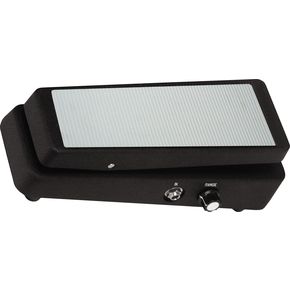
... is the Modtone MT-VOL Xcelerator Volume Pedal .
 I know its not the most exciting piece of gear but it really is a valuable and often overlooked piece of gear. Yeah, the guy who has a massive pedal collection is going to have one, and many people may consider a volume pedal as a luxury or maybe redundant, after all, why not just use the knob on the guitar. Well these are all good points, but those who know how to use a volume wisely can explore new and interesting sound that were impossible, or at the very lest, very difficult to do with out one of these pedals.
Swells: I know that these are possible with your volume knob, but they are a pain. Personally, my hand doesn't work well enough to pull of great sounding swells just by using the volume control on my Tele. Pedals are right there at your feet waiting for there moment to shine.
Muting/ Silent Tuning: If you haven't already gotten a tuner with a silent tuning feature, or if you don't want yet another pedal between you and your amp. Often a volume pedal (such as the Modtone MT-VOL Xcelerator Volume Pedal) has a aux out that stays hot even when the output is muted (heel down). Silence when you need it is just as important as the noise you'll be making.
Chain Placement/Gain control: Like many guitarist I use the Gain on my amp to create a dirty sound, but I also use an overdrive pedal to add distortion and volume (kind of a double wammy). I've chosen an atypical spot for my volume. It is after my overdrive and before my delay. This way I can play with swells in my delay and control my overdriven sound without effecting the distortion. Although the gain from the amp will be effected. I can still control the amount of distortion the pedal is producing with the volume on my guitar (hey, Im not a virtuoso but I can still tweak it is mid-play). So in short, the pedal controls the amps gain, and the volume on the guitar can tweak the pedal and overall line signal.
A volume pedal is a great tool to have. This one is a passive modal, so it takes no juice to operate. Thats great because I'm out of room on my One Spot Chain (also a great piece of gear). Another reason I'm so excited about the particular piece of gear is that I picked it up on Amazon for what under MF's price. Shop around, there are better deals out there than the big guys, but buyer be ware, some seller are not on the ball! In the corse of this blog I convened my self I should now use my aux out for my tuner and run from my delay to the amp. Soon I hope to post a blog about my rig and what/why I use the gear that I do.
Till Next Time
Swells: I know that these are possible with your volume knob, but they are a pain. Personally, my hand doesn't work well enough to pull of great sounding swells just by using the volume control on my Tele. Pedals are right there at your feet waiting for there moment to shine.
Muting/ Silent Tuning: If you haven't already gotten a tuner with a silent tuning feature, or if you don't want yet another pedal between you and your amp. Often a volume pedal (such as the Modtone MT-VOL Xcelerator Volume Pedal) has a aux out that stays hot even when the output is muted (heel down). Silence when you need it is just as important as the noise you'll be making.
Chain Placement/Gain control: Like many guitarist I use the Gain on my amp to create a dirty sound, but I also use an overdrive pedal to add distortion and volume (kind of a double wammy). I've chosen an atypical spot for my volume. It is after my overdrive and before my delay. This way I can play with swells in my delay and control my overdriven sound without effecting the distortion. Although the gain from the amp will be effected. I can still control the amount of distortion the pedal is producing with the volume on my guitar (hey, Im not a virtuoso but I can still tweak it is mid-play). So in short, the pedal controls the amps gain, and the volume on the guitar can tweak the pedal and overall line signal.
A volume pedal is a great tool to have. This one is a passive modal, so it takes no juice to operate. Thats great because I'm out of room on my One Spot Chain (also a great piece of gear). Another reason I'm so excited about the particular piece of gear is that I picked it up on Amazon for what under MF's price. Shop around, there are better deals out there than the big guys, but buyer be ware, some seller are not on the ball! In the corse of this blog I convened my self I should now use my aux out for my tuner and run from my delay to the amp. Soon I hope to post a blog about my rig and what/why I use the gear that I do.
Till Next Time
Subscribe to:
Posts (Atom)