This year at NAMM, Ibanez has unveiled a new pedal. It is a collaboration with a Japanese pedal maker, Vemuram. Vemuram has made a name for themselves by using high-quality parts and outstanding quality control. The TSV808 looks like a beautiful example of simplicity and elegance in aesthetics. This pedal might look spectacular, but what's new with the Vemuram Tube Screamer?
Nearly anyone who has ever made an effect pedal has made a tube scream., and I do mean everyone. It's almost a right of passage for budding pedal builders to make this simple circuit. I love a tube screamer in my rig, but I don't pretend to hear a wide range of difference in the different shades of green. I own a 1980s TS9 and it is still a toss-up between a decent clone. So, this is a pretty reissue of a TS808 made with a boutique pedal builder. If you like that kind of thing, then this is for you. It doesn't really speak to me, but this is more about a new twist on an old favorite.
Showing posts with label New Gear. Show all posts
Sunday, January 27, 2019
Wednesday, December 5, 2018
BOSS Nextone Amplifier (EL84 Setting) Vs Vox AC15
The BOSS Nextone amp is the newest amp to come from BOSS. Fresh off of the success of the Katana amps, the Nextone takes a page from the Katana, but clearly shares DNA with the Blues Cube series. It features four different tube settings. For the sake of this review, I'm focusing on the EL84 British setting, so I'm comparing it with my Vox AC15 combo.
Cleans:
Right out of the gate, the Nextone is impressive. I am a fan of Vox amps. I've owned and used a Vox for years. In the room, playing big open chords, the chime is there. The sound is big and focused. Of course, with reverb and delay, the sound is pure ambient greatness. There is note definition without a hint of mud. While the higher register is bright and chimey, The experience with lower notes is where we lose some of the similarities. It may be due to the different cab designs, but the Vox seems to shake everything around it. At similar volumes, the BOSS doesn't seem to resonate as well. Besides that, the BOSS produces great clean sounds, but it lacks the big bottom-end that the Vox has.
Crunch:
I've recently discovered that the Vox dirty sounds are somewhat... polarising. Where I enjoy turning up my AC15, others can't stand the sound. Now, guitarists are known to be a tiny-bit particular about their tone so the difference between love and hate could be psychosomatic, but it is a difference of opinion. Vox may not be known for their crunch sounds, but I enjoy how the breakup is a little trashy with a big bottom-end and chimey highs. As I increased the gain on the Nextone however, the breakup was not the same. It wasn't bad, but this was probably most different the amps sounded during the test. I did my best to EQ the Nextone a little closer. No dice.
Recording:
So, the amp I used for comparison is the Nextone Studio. I decide to make a short recording I could go back and listen without the influence of room noise. I listened to both amps through headphones to compare. What I found is that the clean tones are impressively similar. While I enjoyed the way the Vox filled the room when playing live, recording by micing the speaker removed that effect entirely. The Crunch tones again were where I heard the most difference again. The breakup was a little more generic than the Vox. The Nextone wasn't bad, but it's not a replacement for my Vox.
Conclusion:
The BOSS Nextone isn't a stand-in for a list of amps, but in the case of the EL84 setting emulating a Vox. It does a decent job of copying the clean chime. During recording, the results are similar. One isn't far and away better, and that is probably the best thing you could say about this amp. It's a little like cooking with garlic powder instead of fresh garlic. Is the product better with one over the other? Probably. Is the product drastically different at the end of the day? Not really. The Nextone is what it is. When it is all said and done. It is a Solid State amp doing an impressive job at imitating a tube amp.
Cleans:
Right out of the gate, the Nextone is impressive. I am a fan of Vox amps. I've owned and used a Vox for years. In the room, playing big open chords, the chime is there. The sound is big and focused. Of course, with reverb and delay, the sound is pure ambient greatness. There is note definition without a hint of mud. While the higher register is bright and chimey, The experience with lower notes is where we lose some of the similarities. It may be due to the different cab designs, but the Vox seems to shake everything around it. At similar volumes, the BOSS doesn't seem to resonate as well. Besides that, the BOSS produces great clean sounds, but it lacks the big bottom-end that the Vox has.
Crunch:
I've recently discovered that the Vox dirty sounds are somewhat... polarising. Where I enjoy turning up my AC15, others can't stand the sound. Now, guitarists are known to be a tiny-bit particular about their tone so the difference between love and hate could be psychosomatic, but it is a difference of opinion. Vox may not be known for their crunch sounds, but I enjoy how the breakup is a little trashy with a big bottom-end and chimey highs. As I increased the gain on the Nextone however, the breakup was not the same. It wasn't bad, but this was probably most different the amps sounded during the test. I did my best to EQ the Nextone a little closer. No dice.
Recording:
So, the amp I used for comparison is the Nextone Studio. I decide to make a short recording I could go back and listen without the influence of room noise. I listened to both amps through headphones to compare. What I found is that the clean tones are impressively similar. While I enjoyed the way the Vox filled the room when playing live, recording by micing the speaker removed that effect entirely. The Crunch tones again were where I heard the most difference again. The breakup was a little more generic than the Vox. The Nextone wasn't bad, but it's not a replacement for my Vox.
Conclusion:
The BOSS Nextone isn't a stand-in for a list of amps, but in the case of the EL84 setting emulating a Vox. It does a decent job of copying the clean chime. During recording, the results are similar. One isn't far and away better, and that is probably the best thing you could say about this amp. It's a little like cooking with garlic powder instead of fresh garlic. Is the product better with one over the other? Probably. Is the product drastically different at the end of the day? Not really. The Nextone is what it is. When it is all said and done. It is a Solid State amp doing an impressive job at imitating a tube amp.
Wednesday, November 21, 2018
BOSS Nextone Amps vs BOSS Katana Amps... FIGHT!
Recently, BOSS has given us the Nextone amps. They are heavily inspired/based on the Roland Blue Cube amps. If you can remember, there was a time before BOSS release the Katana amplifiers where Roland's (BOSS' parent company) biggest amp line was the Cube series. Many people played and loved the Cube amps. Some of the most praised amps in the line were the Blues Cube. The Blues Cube was designed as a direct competitor to the Fender 1x12 amps. Following in that line, the Nextone amps are a continuation of that idea. I think that the Nextone is better than the Blues Cube in nearly every way. However, is it worth it?
I've talked a lot about the BOSS Katana on here so I won't go in a lot of detail in this post. I, like many other people like the Katana amps. I own a Katana amp. It makes a great practice amp. It makes a good gigging amp. You can record direct and mic it with reasonable (or even impressive) results. I think the most impressive thing about the Katana amps is the price. BOSS may have not have realized how big of a success the Katana was going to be. The Katana was priced less than it is now when it was released, suggesting that it was undervalued at release. So the Katana if a huge value that can serve in a multitude of roles.
There are key points were the Nextone amps are similar to Katana. Obviously, BOSS wants to emulate the Katana's success. The most obvious similarities are the power limiting feature (which actually was featured of the Blues Cube before the Katana) and the way the back panel is set up. The Blues Cube had much less in the way of options. However, the back panel of the Nextone and Katana look almost identical. There are some major differences as well. The biggest may be the effects that are built in. Katana promised a huge list of effects that you could select from and control. The Nextone gives you some effects that you might find of small tube combos (reverb, trem, and even delay). Where the Nextone can really flex is power section emulation. This is a solid state amp, but you can select the type of tubes emulated the amp emulates. In practice, this voices the amp like two different American amp or two British amp.
Both of these amps sound good.
Both of these amps have good In/Outs.
The Katana has more effects.
The Nextone models/emulates 4 different Tube amps.
The Katana has 5 amp charactors/modes (which is different?!)
The Nextone has software support to customize your amp voicing.
But UGT! Which one should I buy? The obvious answer is to play both side by side and buy the one you like more. But let's say that you have to buy one or the other without playing either one. If the difference in price doesn't matter, then it mostly comes down to effect. If you have a pedal board then I'd lean toward the Nextone. However, if you need a amp that does effects as well, you might want to go with the Katana, but they are limited. Which one is better overall. Not surprisingly, the more expensive one is going to have a better speaker and cabinet.
Conclusion
BOSS is killing it with their amps. I am very impressed. At a very glance, these amp look very similar. There are some key differences that make the Nextone very impressive. I'd go so far to say that these amps are what the Katana Artist should have been. If the Nextone retained the effects section from the Katanna, it would be game over.
I've talked a lot about the BOSS Katana on here so I won't go in a lot of detail in this post. I, like many other people like the Katana amps. I own a Katana amp. It makes a great practice amp. It makes a good gigging amp. You can record direct and mic it with reasonable (or even impressive) results. I think the most impressive thing about the Katana amps is the price. BOSS may have not have realized how big of a success the Katana was going to be. The Katana was priced less than it is now when it was released, suggesting that it was undervalued at release. So the Katana if a huge value that can serve in a multitude of roles.
There are key points were the Nextone amps are similar to Katana. Obviously, BOSS wants to emulate the Katana's success. The most obvious similarities are the power limiting feature (which actually was featured of the Blues Cube before the Katana) and the way the back panel is set up. The Blues Cube had much less in the way of options. However, the back panel of the Nextone and Katana look almost identical. There are some major differences as well. The biggest may be the effects that are built in. Katana promised a huge list of effects that you could select from and control. The Nextone gives you some effects that you might find of small tube combos (reverb, trem, and even delay). Where the Nextone can really flex is power section emulation. This is a solid state amp, but you can select the type of tubes emulated the amp emulates. In practice, this voices the amp like two different American amp or two British amp.
Both of these amps sound good.
Both of these amps have good In/Outs.
The Katana has more effects.
The Nextone models/emulates 4 different Tube amps.
The Katana has 5 amp charactors/modes (which is different?!)
The Nextone has software support to customize your amp voicing.
But UGT! Which one should I buy? The obvious answer is to play both side by side and buy the one you like more. But let's say that you have to buy one or the other without playing either one. If the difference in price doesn't matter, then it mostly comes down to effect. If you have a pedal board then I'd lean toward the Nextone. However, if you need a amp that does effects as well, you might want to go with the Katana, but they are limited. Which one is better overall. Not surprisingly, the more expensive one is going to have a better speaker and cabinet.
Conclusion
BOSS is killing it with their amps. I am very impressed. At a very glance, these amp look very similar. There are some key differences that make the Nextone very impressive. I'd go so far to say that these amps are what the Katana Artist should have been. If the Nextone retained the effects section from the Katanna, it would be game over.
Monday, November 19, 2018
Ugly Guitar Truth: Boss Nextone Amplifier
Boss has been known for creating some of the most iconic and memorable guitar products of all time. A few years ago the world was taken aback when BOSS gave us the Katana amplifier. The internet was abuzz with talk about an amplifier that gave you tonnes of useful features and BOSS-quality effects. The Katana was not the first, but what made it a darling was that it started for $200. For what many pay for their first "beginner" amp, you could have an amplifier that could get you through your first gigs or be a respectable studio tool. I personally love the line-in and headphone functions. Many of my larger amp and combos don't include this feature. So it's nice to have this on an amp that doesn't make me feel like a compromising tone-wise.
I like the Katana, but why am I take about the Katana on a post about the Nextone amp? Well, my first thought I had about the Nextone, was that it was just an update/addition to the Katana series. Since the introduction, BOSS has added many more Katana models. I can't speak to have the success they all have been, but the Nextone seemed to be at home next to the Katana amp. However, this is not the case.
We've Seen These Before
The Nextone amplifiers are the newest amps from BOSS, and you wouldn't be wrong to think that they share some DNA with the runaway success that was the Katana line of amps. However, these amps are more closely related to the Roland Blues Cube. With just a look, we can see the similarities on the control panel. The channel controls are set up exactly the same. You still have the Tone and Boost controls, Tube Logic and Power Control that we are used to seeing of the Blues Cube. Is this a reheated Blues Cube sold under the BOSS brand? Well, in a word, no.
Something New
While this might have started life as Blues Cube, BOSS has taken lessons from the Katana and applied them to this amp. We can see it most clearly in the effects. The effects are one of the most impressive features of the Katana (besides the solid foundation of good tones). While we don't have the impressive library of effect from the Katana we do have delay, reverb, and trem built in with similar controls to the Katana. The main claim to fame the Nextone is the selectable "Power Section". You can select from 6V6, 6L6, EL84, and EL34 which are just coded names for American and British-type amps. In addition to what we can see on the outside of the amp, BOSS has created an editing software tool to support the backend of the amplifier. This is supposed to give you in-depth control over the "Bias" and "Sag" just like a tube amp. You can also change the EQ across the entire amp and play with how your effects loop operates. The Nextone editing software will also let you change the Boost function into a compressor. So, that's kinda neat.
Conclusion
I never really liked the Blues Cube series. In theory the Blues Cube is a good choice, but I always felt that if you were going to spend Blues Jr. money, then you should probably buy a Blues Jr. (although if you picked up a used Blues Jr. and put the money you saved and bought some effects, then you'd be much better off). However, BOSS has put a lot more into the Nextone. There a lot of features packed into these amps. Sometimes that spell disaster, but BOSS has impressed me with this kind of thing before. "Nextone" is a trash name, however. There is no getting around that. It brings to mind brands like Nux and Hotone for some reason. Both of which I wouldn't want to be associated with my top-shelf combo amps. They are handsome, so hopefully, that's enough to offset a throwaway name. Will I buy one? Let's just say that I'm interested.
I like the Katana, but why am I take about the Katana on a post about the Nextone amp? Well, my first thought I had about the Nextone, was that it was just an update/addition to the Katana series. Since the introduction, BOSS has added many more Katana models. I can't speak to have the success they all have been, but the Nextone seemed to be at home next to the Katana amp. However, this is not the case.
We've Seen These Before
The Nextone amplifiers are the newest amps from BOSS, and you wouldn't be wrong to think that they share some DNA with the runaway success that was the Katana line of amps. However, these amps are more closely related to the Roland Blues Cube. With just a look, we can see the similarities on the control panel. The channel controls are set up exactly the same. You still have the Tone and Boost controls, Tube Logic and Power Control that we are used to seeing of the Blues Cube. Is this a reheated Blues Cube sold under the BOSS brand? Well, in a word, no.
Something New
While this might have started life as Blues Cube, BOSS has taken lessons from the Katana and applied them to this amp. We can see it most clearly in the effects. The effects are one of the most impressive features of the Katana (besides the solid foundation of good tones). While we don't have the impressive library of effect from the Katana we do have delay, reverb, and trem built in with similar controls to the Katana. The main claim to fame the Nextone is the selectable "Power Section". You can select from 6V6, 6L6, EL84, and EL34 which are just coded names for American and British-type amps. In addition to what we can see on the outside of the amp, BOSS has created an editing software tool to support the backend of the amplifier. This is supposed to give you in-depth control over the "Bias" and "Sag" just like a tube amp. You can also change the EQ across the entire amp and play with how your effects loop operates. The Nextone editing software will also let you change the Boost function into a compressor. So, that's kinda neat.
Conclusion
I never really liked the Blues Cube series. In theory the Blues Cube is a good choice, but I always felt that if you were going to spend Blues Jr. money, then you should probably buy a Blues Jr. (although if you picked up a used Blues Jr. and put the money you saved and bought some effects, then you'd be much better off). However, BOSS has put a lot more into the Nextone. There a lot of features packed into these amps. Sometimes that spell disaster, but BOSS has impressed me with this kind of thing before. "Nextone" is a trash name, however. There is no getting around that. It brings to mind brands like Nux and Hotone for some reason. Both of which I wouldn't want to be associated with my top-shelf combo amps. They are handsome, so hopefully, that's enough to offset a throwaway name. Will I buy one? Let's just say that I'm interested.
Labels:
Amplifier,
Blues Cube,
Boss,
Delay,
Effects,
Katana,
New Gear,
Nextone,
Reverb,
Roland,
Tube Logic,
Ugly Guitar Truth
Wednesday, October 24, 2018
Return Of Haunting Mids (JHS Haunting Mids Effect Pedal)
I've spoken before about this pedal from JHS. The Haunting Mids was a limited release pedal that JHS released last October. It is now Spoketober once again, so JHS himself took to his new forum, youtube, to tell everyone about it. In this video, he goes on to tell us some interesting facts about the Haunting Mids pedal. Let's talk about Haunting Mids.
Mids That Are Haunting
Last year when this pedal was released there were some that claimed that this pedal was taken from a pedal building forum called Haunting Mids. Many people took offense to this, however, there seems to be little to no evidence of this. I criticized the pedal for its limited scope and function. However, in the video just released by JHS, one of the main topics of discussion was why they named the pedal "Haunting Mids". The reason is pretty simple. Haunting is to Mids as Transparent is to Overdrive. Haunting is just a word used to describe mids. It is simple, boring and seasonally appropriate.
Mids Only
Many people criticize JHS for many reasons. I can't endorse this pedal, but I can recognize the perfect way this pedal was marketed. The pedal is not without merit, but I think they knew that this pedal wasn't going to move a lot of units. So, they decided to release it in limited release. Doing this not only allows JHS to sell to those looking for a very particular pedal but also to collectors and oddity seekers.
Conclusion
Do you need a Haunting Mids pedal from JHS? No, I'd also argue that no one actually does. Do you want one? Maybe, I don't know. But even though it is something that I can recognize as something that isn't really necessary, and a graphic equalizer can function in the same way (maybe better). It's hard to say that this pedal isn't desirable. It's interesting, it's unique, it's haungtin...
Labels:
Equalizer,
Halloween,
Haunting Mids,
JHS,
Limited release,
Mids,
New Gear,
Spooktober,
Ugly Guitar Truth
Tuesday, October 16, 2018
Ugly Guitar Truth: Fender Full Moon Distortion
While I may have posted about this before, one of my first pedals was a Fender. It was their California Series pedal tuner. The thing was complete crap. It hardly worked, and that is still being generous. I got rid of that and switched to the BOSS TU-2 that is still working like day one. Fender pedals don't have a great reputation, but their new line of pedals is doing a lot to change that. Let's look at the Fender Full Moon Distortion.
That Name
I don't dislike the name that Fender has given their new high gain distortion pedal, but at the same time, it is not great. The strongest statement that I can make about it is that it is extremely forgettable. Thankfully, the pedal is not as forgettable. Unlike the pedals of Fender past, the Full Moon distortion is not a pedal that they want people to forget about. High distortion pedals have a habit to come with some extra knobs and switches, both of which the Full Moon has. So is this a pedal that will fade into the sea of high gain pedals? Well, it does have some things going for it.
The Sounds
It's been a minute since I was a really metal-player. My signal chain either contained a Metal Zone plus EQ and boost or it was just an overdrive into a gunned amp. There are tons of options for metal players out there now. The Full Moon is just the newest in a long line of pedals, but is there anything that makes this pedal stand out? A little bit. You have your basic layout of tone controls (High, Mids, and Lows) but then you get a Hi-Trem that lets you smooth off the super-high-end. You also get a basic Boost function which is nice. In addition to all that, you also get a switch to go between symmetrical and asymmetrical clipping and another for "Bite". Bite will boost your high-mids and give you more pick-attack. Both of the switches make subtle changes, but I am a sucker for things to fiddle with. With all of these options, it is pretty easy to dial in a sound that is pleasing to the player. Going into a clean amp, it is easy to achieve great rock tones with the gain dialed back a bit. Cranking the gain is naturally rewarding as well. Yes, this high-gain pedal does high-gain well.
Conclusion
Fender has set themselves up to compete with the best pedal builders out there today. The pedals are pretty and boutique-ish. If this were coming from a smaller builder, I would expect to pay a lot more. But because Fender is... Fender. They can mass produce and keep cost down. Make the Full Moon distortion an attractive pedal for a guitarist that is looking to find a pedal with plenty of gain and flexibility.
That Name
I don't dislike the name that Fender has given their new high gain distortion pedal, but at the same time, it is not great. The strongest statement that I can make about it is that it is extremely forgettable. Thankfully, the pedal is not as forgettable. Unlike the pedals of Fender past, the Full Moon distortion is not a pedal that they want people to forget about. High distortion pedals have a habit to come with some extra knobs and switches, both of which the Full Moon has. So is this a pedal that will fade into the sea of high gain pedals? Well, it does have some things going for it.
The Sounds
It's been a minute since I was a really metal-player. My signal chain either contained a Metal Zone plus EQ and boost or it was just an overdrive into a gunned amp. There are tons of options for metal players out there now. The Full Moon is just the newest in a long line of pedals, but is there anything that makes this pedal stand out? A little bit. You have your basic layout of tone controls (High, Mids, and Lows) but then you get a Hi-Trem that lets you smooth off the super-high-end. You also get a basic Boost function which is nice. In addition to all that, you also get a switch to go between symmetrical and asymmetrical clipping and another for "Bite". Bite will boost your high-mids and give you more pick-attack. Both of the switches make subtle changes, but I am a sucker for things to fiddle with. With all of these options, it is pretty easy to dial in a sound that is pleasing to the player. Going into a clean amp, it is easy to achieve great rock tones with the gain dialed back a bit. Cranking the gain is naturally rewarding as well. Yes, this high-gain pedal does high-gain well.
Conclusion
Fender has set themselves up to compete with the best pedal builders out there today. The pedals are pretty and boutique-ish. If this were coming from a smaller builder, I would expect to pay a lot more. But because Fender is... Fender. They can mass produce and keep cost down. Make the Full Moon distortion an attractive pedal for a guitarist that is looking to find a pedal with plenty of gain and flexibility.
Labels:
Distortion,
Fender,
Full Moon,
Guitar Pedal,
New,
New Gear,
Pedal,
Summer NAMM,
Ugly Guitar Truth
Monday, October 15, 2018
Ugly Guitar Truth: The Fender Pelt Fuzz Pedal
I've talked about Fender's current line of pedals on here before. Personally, I like the concept. It's probably the best offering from Fender effects that I've seen maybe ever.
Here's a story:
I bought a fender twin. It was brand new from the store. I loved the cleans. I was transitioning from metal player to whatever it is I am not, so at the time I thought this was a smaller (quieter) amp. I got the amp home and started messing around with all the knobs and whatnot. Hooked up the pedal and quickly realized that it didn't work. The amp switch had two or three buttons and it was completely DOA. So I take the rig back to the store and they swap the pedal out for a new one. This one had a bad switch in it. They couldn't find a pedal that actually worked. Does this have anything to do with the Fender Pelt Fuzz? No, not really, but it does give you a point of reference for my impression of Fender pedals. It didn't help that they released a line of pedals that looked more like accessories you would see on a desk of a middle-aged man that collects model cars and has a Fender Stratocaster mouse pad. Then we got direct from China mini pedals that weren't bad but they were what they were. So, I feel like you can hold my Fender pedal skepticism against me.
It's Fuzzy
Ok, duh, but let me explain. The world of Fuzz has exploded in the last few years. It has never really disappeared, but today we have more options for fuzz than ever before. I know that everyone first DIY pedal is a fuzz. They are very simple circuits to build, but recently we have seen the rise of complicated fuzz pedals. This one is no different. The granddaddy of all silicon fuzz, the Fuzzface, had only two knobs. Even the addition of two knobs was a technical marvel compared to the circuits origins. Now we have pedals like the Pelt. Not only do we have the familiar Volume, Tone, Gain knobs, but we get a Bloom knob and two switches for Mid (Contour) and Thick (Bass Boost Cut/Boost). The pedal has enough fuzz to nearly lose the guitar in the noise of the pedal. Fender also claims that the pedal responds well to rolling the volume down on your guitar. Fuzz pedals have a bad habit of cutting out or become more splatty when lowing volume is applied, but the Pelt is supposed to clean up. In my experience, the pedal doesn't clean up as much as it gets darker with lower volume. This may work relatively the same in a band situation. There may be no real way to get around how the circuit actually works.
It's Pretty
This may not be my favorite look that I've ever seen on a pedal, but it is far and away the best one that I've seen on a Fender pedal. It's not even much of a contest. These are the first pedal that I feel like they actually care anything about, so they had to give them an aesthetic that wasn't embarrassing to be seen with. The Amp jewel cover is a nice touch. I am a little worried about the magnetic battery door. It's begging to get crushed by a stray stomp, so be careful I guess. The backlit knobs are cool until you are on a dark stage and those lights are the only thing you can see and you can't tell you are changing the Tone or Gain knob. They pumped these pedals full of features, but this is basically Fender's first grown-up pedal line, so they still have refining to do.
Conclusion
I like this pedal. I haven't said a lot of great things about it, so you should know that this pedal is one of the better sounding fuzz pedals that I've seen come out lately. I'm a pretty big fan of the Big Muff style of Fuzz, but the Pelt is a robust pedal capable of being more than that one sound on that one song. Even though I really dig the Big Muff sound, do I have one on my board? No. The Pelt Fuzz is much more of a sonic tool that I could see actually using in a rig. The price is also something of importance. Lately, EHX has put out clones of the Big Muff in its many stages (Triangle, Russian, Silicon) and for the price of just two of those, you can have the Pelt. I may or may not own more than one of these pedals, and I may or may not wish I had the Pelt... just saying.
Here's a story:
I bought a fender twin. It was brand new from the store. I loved the cleans. I was transitioning from metal player to whatever it is I am not, so at the time I thought this was a smaller (quieter) amp. I got the amp home and started messing around with all the knobs and whatnot. Hooked up the pedal and quickly realized that it didn't work. The amp switch had two or three buttons and it was completely DOA. So I take the rig back to the store and they swap the pedal out for a new one. This one had a bad switch in it. They couldn't find a pedal that actually worked. Does this have anything to do with the Fender Pelt Fuzz? No, not really, but it does give you a point of reference for my impression of Fender pedals. It didn't help that they released a line of pedals that looked more like accessories you would see on a desk of a middle-aged man that collects model cars and has a Fender Stratocaster mouse pad. Then we got direct from China mini pedals that weren't bad but they were what they were. So, I feel like you can hold my Fender pedal skepticism against me.
It's Fuzzy
Ok, duh, but let me explain. The world of Fuzz has exploded in the last few years. It has never really disappeared, but today we have more options for fuzz than ever before. I know that everyone first DIY pedal is a fuzz. They are very simple circuits to build, but recently we have seen the rise of complicated fuzz pedals. This one is no different. The granddaddy of all silicon fuzz, the Fuzzface, had only two knobs. Even the addition of two knobs was a technical marvel compared to the circuits origins. Now we have pedals like the Pelt. Not only do we have the familiar Volume, Tone, Gain knobs, but we get a Bloom knob and two switches for Mid (Contour) and Thick (Bass Boost Cut/Boost). The pedal has enough fuzz to nearly lose the guitar in the noise of the pedal. Fender also claims that the pedal responds well to rolling the volume down on your guitar. Fuzz pedals have a bad habit of cutting out or become more splatty when lowing volume is applied, but the Pelt is supposed to clean up. In my experience, the pedal doesn't clean up as much as it gets darker with lower volume. This may work relatively the same in a band situation. There may be no real way to get around how the circuit actually works.
It's Pretty
This may not be my favorite look that I've ever seen on a pedal, but it is far and away the best one that I've seen on a Fender pedal. It's not even much of a contest. These are the first pedal that I feel like they actually care anything about, so they had to give them an aesthetic that wasn't embarrassing to be seen with. The Amp jewel cover is a nice touch. I am a little worried about the magnetic battery door. It's begging to get crushed by a stray stomp, so be careful I guess. The backlit knobs are cool until you are on a dark stage and those lights are the only thing you can see and you can't tell you are changing the Tone or Gain knob. They pumped these pedals full of features, but this is basically Fender's first grown-up pedal line, so they still have refining to do.
Conclusion
I like this pedal. I haven't said a lot of great things about it, so you should know that this pedal is one of the better sounding fuzz pedals that I've seen come out lately. I'm a pretty big fan of the Big Muff style of Fuzz, but the Pelt is a robust pedal capable of being more than that one sound on that one song. Even though I really dig the Big Muff sound, do I have one on my board? No. The Pelt Fuzz is much more of a sonic tool that I could see actually using in a rig. The price is also something of importance. Lately, EHX has put out clones of the Big Muff in its many stages (Triangle, Russian, Silicon) and for the price of just two of those, you can have the Pelt. I may or may not own more than one of these pedals, and I may or may not wish I had the Pelt... just saying.
Labels:
Big Muff,
Fender,
Fuzz,
Fuzz pedal,
Guitar Pedal,
Muff,
New Gear,
Pelt,
Ugly Guitar Truth
Friday, October 12, 2018
Ugly Guitar Truth: EHX Grand Canyon Delay and Looper
It's been a year since the release of the EHX Canyon Delay and now EHX has announced the Grand Canyon Delay and Looper. It is a full-featured delay with expanded capabilities, a longer list of features, and dual switches. For fans of the original Canyon Delay, this is an obvious upgrade. While I loved the Canyon for its overstuffed feature set and compact size, the question of whether or not the Grand Canyon continues this trend is harder to answer. Let's take a look.
Size Isn't Everything
While I personally love dual-sized delays (mostly because of my fondness for my DD-20) the form factor plays a big rule in how this pedal is used. The original Canyon Delay was packed with features such as a "secret sub-menu" that allows you to edit modulations and other features depending on the settings. This would allow you to edit settings on the fly that you normally wouldn't be able to on a normal compact delay. However, there is no interface on the pedal, so the learning curve is a little steep, and on-the-fly edits would require a pretty deep familiarity with how this pedal operates. That's why the size of the Grand Canyon is important. The increased size lets you interact with pedal relatively easily. It also allows the addition of stereo ins and outs.
Quarter-Of-A-Grand Canyon
Price. When you pedal was announced, my biggest question was about price. I loved the original, but what was going to make or break this pedal is the price. It was a given that the price-floor for this pedal was going to be around $200. The Canyon sells for $140. It is a direct competitor to the TC Flashback II. The Canyon undercuts the price of the Flashback by $30 and offers a load of options without needing to be connected to a computer/phone. There is definitely a market for those that want a full featured, single-sized delay pedal that has no intention on updating patches. EHX delivered to those people. The Grand Canyon is yet another calculated play by EHX. This is a full-featured dual-sized delay that slides in under the price of every other modern delay in its category. While I would have loved to see this pedal in the $200-225 range (because I'm cheap), The $250 price tag is more than enough to not cannibalize sells of the original, but any higher it would start getting compared to the big flagship digital delay without the vibranium shield of "for the price".
For The Price
$200 doesn't buy the pedal it used to. I walked into my local guitar shop ready to buy the best delay they had. I had my choice of a Line6 DL4 and a BOSS DD-20. Both were about $200 bucks. Now, delays are just a computer with a special purpose. The BOSS DD-500 Costs $350 and blows the DD-20 out of the water when comparing features. A modern, high-powered, digital delay will cost $300 and up. Since the Grand Canyon is slipping in just under that mark, then you are going to hear a lot of "for the price arguments". "It doesn't do everything the DD-500, but for the price..." Feel free to substitute DD-500 for another big brained delay and mark my words.
Conclusion
The Grand Canyon looks like a feature-rich, intuitive pedal that seems poised to be successful. I think about the guy walking to the guitar shop looking for a delay. He doesn't want to spend the rest of the day reading a user manual. He wants to buy a pedal, head to a gig, and find some cool sounds. Sure, he might buy a DD-7 or a Flashback II, or maybe he'll buy the Grand Canyon.
Size Isn't Everything
While I personally love dual-sized delays (mostly because of my fondness for my DD-20) the form factor plays a big rule in how this pedal is used. The original Canyon Delay was packed with features such as a "secret sub-menu" that allows you to edit modulations and other features depending on the settings. This would allow you to edit settings on the fly that you normally wouldn't be able to on a normal compact delay. However, there is no interface on the pedal, so the learning curve is a little steep, and on-the-fly edits would require a pretty deep familiarity with how this pedal operates. That's why the size of the Grand Canyon is important. The increased size lets you interact with pedal relatively easily. It also allows the addition of stereo ins and outs.
Quarter-Of-A-Grand Canyon
Price. When you pedal was announced, my biggest question was about price. I loved the original, but what was going to make or break this pedal is the price. It was a given that the price-floor for this pedal was going to be around $200. The Canyon sells for $140. It is a direct competitor to the TC Flashback II. The Canyon undercuts the price of the Flashback by $30 and offers a load of options without needing to be connected to a computer/phone. There is definitely a market for those that want a full featured, single-sized delay pedal that has no intention on updating patches. EHX delivered to those people. The Grand Canyon is yet another calculated play by EHX. This is a full-featured dual-sized delay that slides in under the price of every other modern delay in its category. While I would have loved to see this pedal in the $200-225 range (because I'm cheap), The $250 price tag is more than enough to not cannibalize sells of the original, but any higher it would start getting compared to the big flagship digital delay without the vibranium shield of "for the price".
For The Price
$200 doesn't buy the pedal it used to. I walked into my local guitar shop ready to buy the best delay they had. I had my choice of a Line6 DL4 and a BOSS DD-20. Both were about $200 bucks. Now, delays are just a computer with a special purpose. The BOSS DD-500 Costs $350 and blows the DD-20 out of the water when comparing features. A modern, high-powered, digital delay will cost $300 and up. Since the Grand Canyon is slipping in just under that mark, then you are going to hear a lot of "for the price arguments". "It doesn't do everything the DD-500, but for the price..." Feel free to substitute DD-500 for another big brained delay and mark my words.
Conclusion
The Grand Canyon looks like a feature-rich, intuitive pedal that seems poised to be successful. I think about the guy walking to the guitar shop looking for a delay. He doesn't want to spend the rest of the day reading a user manual. He wants to buy a pedal, head to a gig, and find some cool sounds. Sure, he might buy a DD-7 or a Flashback II, or maybe he'll buy the Grand Canyon.
Labels:
Delay,
EHX,
Electro Harmonix,
Grand Canyon,
guitar effect,
New Gear,
New pedal,
Pedal,
Ugly Guitar Truth
Thursday, October 11, 2018
Ugly Guitar Truth: EHX Mod Rex Polyrthymic Modulator
EHX is one of those companies that cannot be defined in a single sentence. Most people know them for their guitar effects. Many think of their Big Muff Fuzz pedals, others may think of the Memory Man analog delays when they hear EHX. But still, others think of their weird and/or wacky modulation pedals. EHX has done all of these things to varying degrees of success. The Mod Rex definitely fits into that last category. This is Ugly Guitar Truth, so let's look at this pedal.
While there are some terms that guitarists are familiar in the description of this pedal like Flange, Trem, Vibe, and Chorus this pedal is anything but ordinary. It is no wonder that the demonstration of the Mod Rex is as much synth mod as guitar pedal. The demonstrator shows how easy (once set up) to control and create spacey synth rock with this pedal. It's easy to get the impression that the pedal can make you the next Killers, but it is key to remember that the demonstrator is very talented and likely very familiar with the product.
It is true that I like EHX, there are a few things that we need to address. This pedal is impressive, but for a guitarist with a singular focus, this pedal may not be what you are looking for. Yes, it may give you a handful of mod options. It will allow you to control them in many ways that stand-alone pedal may not, but there is a lot in this box that may go completely unused. Not to say this unit isn't an impressive sound modulating tool, but there may be other options out there that better meet the needs of a guitarist looking to mix and blend filters.
Conclusion
For me, I'm passing on this unit. It has loads of features that I'm just not going to use. There are plenty of effects that offer similar feature sets that are more tailored for guitar application. While I commend EHX for their ever forward attitude towards new sounds and features, I'll pass.
While there are some terms that guitarists are familiar in the description of this pedal like Flange, Trem, Vibe, and Chorus this pedal is anything but ordinary. It is no wonder that the demonstration of the Mod Rex is as much synth mod as guitar pedal. The demonstrator shows how easy (once set up) to control and create spacey synth rock with this pedal. It's easy to get the impression that the pedal can make you the next Killers, but it is key to remember that the demonstrator is very talented and likely very familiar with the product.
It is true that I like EHX, there are a few things that we need to address. This pedal is impressive, but for a guitarist with a singular focus, this pedal may not be what you are looking for. Yes, it may give you a handful of mod options. It will allow you to control them in many ways that stand-alone pedal may not, but there is a lot in this box that may go completely unused. Not to say this unit isn't an impressive sound modulating tool, but there may be other options out there that better meet the needs of a guitarist looking to mix and blend filters.
Conclusion
For me, I'm passing on this unit. It has loads of features that I'm just not going to use. There are plenty of effects that offer similar feature sets that are more tailored for guitar application. While I commend EHX for their ever forward attitude towards new sounds and features, I'll pass.
Labels:
EHX,
Electro Harmonix,
Mod Rex,
New Gear,
Ugly Guitar Truth
Wednesday, October 10, 2018
Ugly Guitar Truth: BOSS Waza Craft DC-2W Dimension-C
I don't think I get this one. I understand that it's a vintage pedal that BOSS has released under the Waza label, but other than the vintage appeal, there just isn't anything here that I'm stoked about. I ran a little long in the post about the Waza Metal Zone, so I think this will be shorter.
Ugly Truth in: 3... 2...
1. Presets
I'm a knob tweaker. I love to twist knobs. I like to fine tune all the settings. The biggest reason that I don't own a Strymon pedal is that I would probably be found dead from dehydration next to it because I tried to adjust all the parameters. So the fact that this is a "set it and forget about changing it" type of pedal is a little detracting for me. I get the appeal, but I'd be screaming for a Blend knob right off the bat. I mean, it is a cool pedal with a lot of vintage appeal. Also, you can rig it up in a loop with a blend if you are that into it, but it sounds like a lot of trouble just to run a special pedal with some cool vintage cred.
2. Premium
This pedal isn't for me. The whole Waza line has a particular customer base and 9 times out of 10 I'm not interested. (actually, it's 2 of out 8 so far...) This is the most expensive Waza pedal at 229 USD. No doubt there will be those that buy and love this pedal. Those people probably already know that they will love this pedal before they buy it and they don't mind paying that premium. I'm not cool enough to really "get" this pedal, so my money is better spent on a used MD-500. You get 20 presets with the Dimension-C, but your options are nearly limitless with the MD-500.
3. There is no 3
Conclusion
No doubt there are some cool sounds in this box. If you were stoked when BOSS announced it, then you are the type of person that BOSS made this pedal for. I, however, didn't.
Labels:
Boss,
Boutique,
Custom,
DC-2,
DC-2W,
Guitar Pedals,
New Gear,
New pedal,
Reissue,
rerelease,
Ugly Guitar Truth,
Vintage,
Waza,
Waza Craft
Tuesday, October 9, 2018
The Ugly Truth About BOSS MT-2W WAZA Craft Metal Zone
BOSS decided to break the dang internet, or at least our tiny little corner of it, with the announcement of the BOSS MT-2W. It is regarded by some to be the most despised of all pedals and praised by others for its unique sound and features. Along with the Dimension-C, the Metal Zone has gotten the WAZA treatment. So what does that mean for this divisive pedal? Well, let's take a look at what the BOSS Waza Craft Metal Zone MT-2W has done
First, a little backstory. I think I've shared this before, so I'll keep it brief. I used to play in a metal band. In my search for great metal tone. I, for a time, used a Metal Zone running through a GE-7 into an amp set for the edge of break-up. I still remember that I set the gain all the way down. This pedal had enough gain at zero. The more you turned up the distortion knob, the more noise and hiss came through the pedal. I still think that a Metal Zone running through an EQ is a powerful combination and an easy way to enter metal tone nirvana. So what do I think of BOSS releasing a Waza Metal Zone?
It makes sense. If you really think about it. Waza is the "greatest hits" of BOSS. The first pedals in the line were some of their best sellers. The SD-1 and DS-1 have sold tons of units. Nearly everyone that has gotten into pedals at least knows of these pedals if not owns them. I've owned several of each. (Why? It's hard to say.) But Waza isn't just about BOSS' most popular, current production models. They have rereleased some of the most coveted vintage pedals from the past. The DM-2 has been a vintage favorite for those that crave analog delay tones. The CE-2 is another pedal that saw rerelease in the Waza line. Both of these pedals are often emulated, but it seems like there is still a draw for something backed by BOSS. So why the Metal Zone? It's not as common to see an MT-2 as it is an SD-1, the Metal Zone is still in production, so why then? I think it's the same reason the BD-2 got its custom setting. Modders.
One of the first pedals that I ever modded was a Metal Zone. I liked the pedal, but the noise was always bothersome. So when I stumbled across a mod that was supposed to help with that, I jumped on it. I also killed the first MT-2 I ever tried to mod. eBay loved me. I think this is the reason that BOSS has given the Waza treatment to the MT-2. I hate being too cynical (or maybe I don't. I don't know.), but it makes sense. BOSS doesn't see much money from the modding community. When I modded pedals, I didn't buy a new pedal. I jumped on eBay and bought the cheapest pedal I could in case I screwed up the mod. I'm many others do the same, so BOSS wants to cut out the middleman and sell us the modded pedal up front. It makes all the sense, but is it worth it?
Log story just a little bit longer: yes, it is worth it.
The End
Just Kidding! did you think I wasn't going to talk this point into the ground? Is this your first time here? So, you may have noticed that I haven't talked about what this pedal sounds like. (I mean, if you think about, reading about what a pedal sounds like is a little silly, but hasn't stopped me before) If you like the way the Metal Zone sounds then you'll like the Waza Zone. If you didn't, then you probably won't be blown away by this pedal. If you don't know if you like the Metal Zone or not, then what have you been doing? It's been around for over 20 years... To be honest, this is one of the Waza pedals that I'd be interested in. I don't have very many heavy distortion pedals, and the MT-2 hold a special place in my guitar playing history, so buying a premium/custom version from BOSS for 50% more isn't a stretch.
First, a little backstory. I think I've shared this before, so I'll keep it brief. I used to play in a metal band. In my search for great metal tone. I, for a time, used a Metal Zone running through a GE-7 into an amp set for the edge of break-up. I still remember that I set the gain all the way down. This pedal had enough gain at zero. The more you turned up the distortion knob, the more noise and hiss came through the pedal. I still think that a Metal Zone running through an EQ is a powerful combination and an easy way to enter metal tone nirvana. So what do I think of BOSS releasing a Waza Metal Zone?
It makes sense. If you really think about it. Waza is the "greatest hits" of BOSS. The first pedals in the line were some of their best sellers. The SD-1 and DS-1 have sold tons of units. Nearly everyone that has gotten into pedals at least knows of these pedals if not owns them. I've owned several of each. (Why? It's hard to say.) But Waza isn't just about BOSS' most popular, current production models. They have rereleased some of the most coveted vintage pedals from the past. The DM-2 has been a vintage favorite for those that crave analog delay tones. The CE-2 is another pedal that saw rerelease in the Waza line. Both of these pedals are often emulated, but it seems like there is still a draw for something backed by BOSS. So why the Metal Zone? It's not as common to see an MT-2 as it is an SD-1, the Metal Zone is still in production, so why then? I think it's the same reason the BD-2 got its custom setting. Modders.
One of the first pedals that I ever modded was a Metal Zone. I liked the pedal, but the noise was always bothersome. So when I stumbled across a mod that was supposed to help with that, I jumped on it. I also killed the first MT-2 I ever tried to mod. eBay loved me. I think this is the reason that BOSS has given the Waza treatment to the MT-2. I hate being too cynical (or maybe I don't. I don't know.), but it makes sense. BOSS doesn't see much money from the modding community. When I modded pedals, I didn't buy a new pedal. I jumped on eBay and bought the cheapest pedal I could in case I screwed up the mod. I'm many others do the same, so BOSS wants to cut out the middleman and sell us the modded pedal up front. It makes all the sense, but is it worth it?
Log story just a little bit longer: yes, it is worth it.
The End
Just Kidding! did you think I wasn't going to talk this point into the ground? Is this your first time here? So, you may have noticed that I haven't talked about what this pedal sounds like. (I mean, if you think about, reading about what a pedal sounds like is a little silly, but hasn't stopped me before) If you like the way the Metal Zone sounds then you'll like the Waza Zone. If you didn't, then you probably won't be blown away by this pedal. If you don't know if you like the Metal Zone or not, then what have you been doing? It's been around for over 20 years... To be honest, this is one of the Waza pedals that I'd be interested in. I don't have very many heavy distortion pedals, and the MT-2 hold a special place in my guitar playing history, so buying a premium/custom version from BOSS for 50% more isn't a stretch.
Labels:
Boss,
Boutique,
Custom,
Distortion,
Metal Zone,
MT-2,
MT-2W,
New,
New Gear,
New pedal,
Not a review,
Pedal Mods,
Ugly Guitar Truth,
Waza,
Waza Craft
Wednesday, March 28, 2018
Ugly Guitar Truth: Danelectro Billionaire Pedals
First off, sorry for the extended hiatus. NAMM nearly killed me. Ok, it didn't kill me as much as it burnt me out. I wrote about as much as I did the entire year in the span of a few weeks. Honestly, its hard to find interesting things to talk about all the time anyway. So now that I've given you a few excuses, we will talk about the one thing that I've actually had an opinion on in the last couple of months. Daneletro Billionaire Pedals...
I Hate Them
From the moment I saw them, I did not like a single thing about them. Not that I could avoid seeing them. Obviously, I follow the major guitar manufacturers... and Danelectro. So, I saw these pedals on the daily after their announcement. However, I started seeing them everywhere. In the Blues, 60 Cycle, and today (the day I'm writing this) Andertons all posted videos on Youtube. Others are posting on Twitter and Instagram. Daneletro already looks like they are trying to hard, then they push these pedal via online-influencers. Gag me with a spoon (actually, please don't). Everything from the look, to the names (SRV much?), to the oversaturation of social media, these pedal are just annoying and I hate them.
I Don't Actually Hate Them
I do. That is, I did until I tried them. I sat down with the Big Spender, Pride of Texas, Billionaire Boost, and Filthy Rich. I played a Fender Stratocaster through the previously mentioned pedals into a Peavy Bandit. As much as I wanted to confirm all the dislike I had for these pedals, I was completely corrected. The Pride of Texas overdrive is extremely usable. It invokes its namesake. It performs extremely well in an amp that is less than perfectly clean. The big spender is a super-solid Leslie simulator with a ramp function that adds a ton to this effect. The ramp function isn't adjustable that I'm aware of, but this pedal performs just as well or better than its peers. The Boost and Tremolo are pretty par for the course, but I can't find anything wrong with them.
Conclusion
So, I've gone from actively hating these pedals just based on the marketing and promotion of these pedals to admitting these are perfectly fine. I wouldn't mind owning the Pride of Texas or Big Spender pedals if I needed those effects. I'd only be slightly embarrassed by the way they look.
I Hate Them
From the moment I saw them, I did not like a single thing about them. Not that I could avoid seeing them. Obviously, I follow the major guitar manufacturers... and Danelectro. So, I saw these pedals on the daily after their announcement. However, I started seeing them everywhere. In the Blues, 60 Cycle, and today (the day I'm writing this) Andertons all posted videos on Youtube. Others are posting on Twitter and Instagram. Daneletro already looks like they are trying to hard, then they push these pedal via online-influencers. Gag me with a spoon (actually, please don't). Everything from the look, to the names (SRV much?), to the oversaturation of social media, these pedal are just annoying and I hate them.
I Don't Actually Hate Them
I do. That is, I did until I tried them. I sat down with the Big Spender, Pride of Texas, Billionaire Boost, and Filthy Rich. I played a Fender Stratocaster through the previously mentioned pedals into a Peavy Bandit. As much as I wanted to confirm all the dislike I had for these pedals, I was completely corrected. The Pride of Texas overdrive is extremely usable. It invokes its namesake. It performs extremely well in an amp that is less than perfectly clean. The big spender is a super-solid Leslie simulator with a ramp function that adds a ton to this effect. The ramp function isn't adjustable that I'm aware of, but this pedal performs just as well or better than its peers. The Boost and Tremolo are pretty par for the course, but I can't find anything wrong with them.
Conclusion
So, I've gone from actively hating these pedals just based on the marketing and promotion of these pedals to admitting these are perfectly fine. I wouldn't mind owning the Pride of Texas or Big Spender pedals if I needed those effects. I'd only be slightly embarrassed by the way they look.
Thursday, February 1, 2018
NAMM 2018: JHS Panther Cub V2 Analog Delay
The Panther Cub has been a massively popular pedal for those that love analog, bucket-brigade delays. JHS has somehow stuffed the contents and features of the previous versions into a much smaller package. Good things come in smaller packages because the Cub now has active EQ, Smoother Oscillation, Gain Control, and Full Wet Mix. Everything you love from the original, plus some, in less pedal board real estate.
More Info From JHS:
In 2011, we released the Panther Analog Delay. Almost exactly two years later in 2013, we tried a nearly impossible feat of taking everything we love about the Panther Delay, making a few improvements, and packaging it into an enclosure half the size. Today in 2018 we're repeating the feat and making the Panther Cub V2 half the size once again!
What's New on the V2?
- Half the size of the Panther Cub V1 and Panther Cub V1.5
- Fully Wet Mix now available
- Gain Control to set overall volume
- Even smoother oscillation and run-away
- Active EQ, which functions at a Tilt style EQ
100% Analog Bucket Brigade Technology
The Panther Cub V2 is voiced to deliver the dark and chewy repeats that analog delay fans clamor for. The Panther Cub offers you 1,000ms (one full second) of delay time! Bring in beautiful, ambient modulation with the pedal's modulation controls.
- 1,000ms of Delay (1 full second)
- Four 3205 Bucket Brigade Delay chips
- Onboard Modulation that stays accurate even when using Tap Tempo
Extensive Onboard Control
Thanks to its groundbreaking feature set, the Panther Cub Delay has been one of our most intriguing pedals to date. It's not often you find an all-analog delay with onboard tap tempo and a 4-section RATIO control with settings for quarter, dotted-eighth, eighth, and triplet divisions. In fact, our original Panther Delay was the first to do it in 2011!
- Soft-touch Tap Tempo switch
- 4-position RATIO control (1/4, 1/8, dotted 1/8, Triplets)
- True Speed LED (indicates rate of actual delay)
External Tone-shaping Power
The Panther Cub's control and tweakability extend further than what you'll find onboard. An expression pedal input can be assigned to change many of the pedal's settings on the fly. And you even have the opportunity to externally control your tap tempo and tap slave the Panther Cub to your other time-based pedals.
- Dry Out (via TRS splitter) for stereo field of sound
- Assignable Expression (control Time, Ratio, Modulation)
- Tap Input/Output allows external tap controller or tap slaving
Additional Panther Cub Benefits:
- Even smaller Pedalboard-friendly size
- Space-saving top-mounted Input/Output jacks
- True Bypass Switching
- Standard 9V DC negative power
100% Designed, Populated, and Assembled in Kansas City USA
More Info From JHS:
In 2011, we released the Panther Analog Delay. Almost exactly two years later in 2013, we tried a nearly impossible feat of taking everything we love about the Panther Delay, making a few improvements, and packaging it into an enclosure half the size. Today in 2018 we're repeating the feat and making the Panther Cub V2 half the size once again!
What's New on the V2?
- Half the size of the Panther Cub V1 and Panther Cub V1.5
- Fully Wet Mix now available
- Gain Control to set overall volume
- Even smoother oscillation and run-away
- Active EQ, which functions at a Tilt style EQ
100% Analog Bucket Brigade Technology
The Panther Cub V2 is voiced to deliver the dark and chewy repeats that analog delay fans clamor for. The Panther Cub offers you 1,000ms (one full second) of delay time! Bring in beautiful, ambient modulation with the pedal's modulation controls.
- 1,000ms of Delay (1 full second)
- Four 3205 Bucket Brigade Delay chips
- Onboard Modulation that stays accurate even when using Tap Tempo
Extensive Onboard Control
Thanks to its groundbreaking feature set, the Panther Cub Delay has been one of our most intriguing pedals to date. It's not often you find an all-analog delay with onboard tap tempo and a 4-section RATIO control with settings for quarter, dotted-eighth, eighth, and triplet divisions. In fact, our original Panther Delay was the first to do it in 2011!
- Soft-touch Tap Tempo switch
- 4-position RATIO control (1/4, 1/8, dotted 1/8, Triplets)
- True Speed LED (indicates rate of actual delay)
External Tone-shaping Power
The Panther Cub's control and tweakability extend further than what you'll find onboard. An expression pedal input can be assigned to change many of the pedal's settings on the fly. And you even have the opportunity to externally control your tap tempo and tap slave the Panther Cub to your other time-based pedals.
- Dry Out (via TRS splitter) for stereo field of sound
- Assignable Expression (control Time, Ratio, Modulation)
- Tap Input/Output allows external tap controller or tap slaving
Additional Panther Cub Benefits:
- Even smaller Pedalboard-friendly size
- Space-saving top-mounted Input/Output jacks
- True Bypass Switching
- Standard 9V DC negative power
100% Designed, Populated, and Assembled in Kansas City USA
Labels:
Active Eq,
Bucket Brigade,
Full Wet Mix,
Gain Control,
JHS,
NAMM 2018,
New Gear,
Panther Cub,
Ugly Guitar Truth,
V2
Wednesday, January 31, 2018
NAMM 2018: JSH Andy Timmons V2
The Andy Timmons pedal from JHS has been a huge success for JHS. Guitarist have loved the original so much that JHS has come back with a version 2. So how the guys at JHS have found a way to squeeze a boost into their compact pedal. The boost is selectable via an addition footswitch. If you are a fan of the original, then you might dig applying the AT just the way Andy does. With a specially designed and tuned boost, you can boost it just like Mr. Timmons too.
More Info From JHS:
In 2016 we brought you the AT, Andy Timmons artist signature pedal and we're really proud to bring you the next iteration of this phenomenal stomp box, The AT+.
The JHS Pedals AT is Andy Timmons signature overdrive pedal that gives Andy his unmistakable lead and rhythm tone. Upon purchasing a JHS Angry Charlie in 2013, Andy began using it as his primary tone and soon after got in touch with Josh Scott about modifying it for his needs. Through going back and forth and tailoring it to Andy’s tastes, the “@“ was born and eventually released into production in 2016. This pedal gives you all the soaring overdrive and distortion that you hear from Andy with plenty of options to craft your tone with your rig. So pay ATtention and we’ll see what makes the AT rock.
Does the AT+ sound the same as the original AT?
Yes! The drive channel of the AT+ is identical to our original AT pedal. No changes were made whatsoever and the controls remain the same. They include Volume, EQ, Drive, Air, and a three-way toggle for 25-watt, 50-watt, or 100-watt modes. The Volume gives you plenty of headroom to play with, while the Drive control has a wide range from high gain blues to thunderous distortion. The tone controls work together to give you the ability to shape your tone and sit perfectly in a mix. The EQ works as a standard bright/dark tone control, while the Air control rolls in top end like a presence control so you can have just the right amount of brightness for articulation and clarity. The three-way toggle gives you the feel of different wattage amplifiers. The up position is the 25-watt setting with the most compression and saturation with the least amount of volume. The down position is the 50-watt setting for a good balance of compression and openness. The middle position is the 100-watt position for tons of volume and open crunch while being less focused.
Two channels are better than one!
New to the AT+ is an independent foot-switchable Boost...essentially creating a second channel and gain stage for the pedal. The boost side of the AT+ is a slightly dirty and overdriven pre-boost that allows you to hit the front end of the AT drive channel and achieve more saturation and definition for applications where you need more. Since the Boost is independent, it can be used alone to drive your amp or other drive pedals in conjunction with the AT+ drive channel.
This pedal requires standard 9V DC Negative power, consumes less than 100mA, and measures 2.2"x4.8"x1.6".
You can safely run “The AT“ at 18 or 9 volts.
More Info From JHS:
In 2016 we brought you the AT, Andy Timmons artist signature pedal and we're really proud to bring you the next iteration of this phenomenal stomp box, The AT+.
The JHS Pedals AT is Andy Timmons signature overdrive pedal that gives Andy his unmistakable lead and rhythm tone. Upon purchasing a JHS Angry Charlie in 2013, Andy began using it as his primary tone and soon after got in touch with Josh Scott about modifying it for his needs. Through going back and forth and tailoring it to Andy’s tastes, the “@“ was born and eventually released into production in 2016. This pedal gives you all the soaring overdrive and distortion that you hear from Andy with plenty of options to craft your tone with your rig. So pay ATtention and we’ll see what makes the AT rock.
Does the AT+ sound the same as the original AT?
Yes! The drive channel of the AT+ is identical to our original AT pedal. No changes were made whatsoever and the controls remain the same. They include Volume, EQ, Drive, Air, and a three-way toggle for 25-watt, 50-watt, or 100-watt modes. The Volume gives you plenty of headroom to play with, while the Drive control has a wide range from high gain blues to thunderous distortion. The tone controls work together to give you the ability to shape your tone and sit perfectly in a mix. The EQ works as a standard bright/dark tone control, while the Air control rolls in top end like a presence control so you can have just the right amount of brightness for articulation and clarity. The three-way toggle gives you the feel of different wattage amplifiers. The up position is the 25-watt setting with the most compression and saturation with the least amount of volume. The down position is the 50-watt setting for a good balance of compression and openness. The middle position is the 100-watt position for tons of volume and open crunch while being less focused.
Two channels are better than one!
New to the AT+ is an independent foot-switchable Boost...essentially creating a second channel and gain stage for the pedal. The boost side of the AT+ is a slightly dirty and overdriven pre-boost that allows you to hit the front end of the AT drive channel and achieve more saturation and definition for applications where you need more. Since the Boost is independent, it can be used alone to drive your amp or other drive pedals in conjunction with the AT+ drive channel.
This pedal requires standard 9V DC Negative power, consumes less than 100mA, and measures 2.2"x4.8"x1.6".
You can safely run “The AT“ at 18 or 9 volts.
Labels:
Andy Timmons,
AT,
Boost,
JHS,
NAMM 2018,
New Gear,
Ugly Guitar Truth,
V2
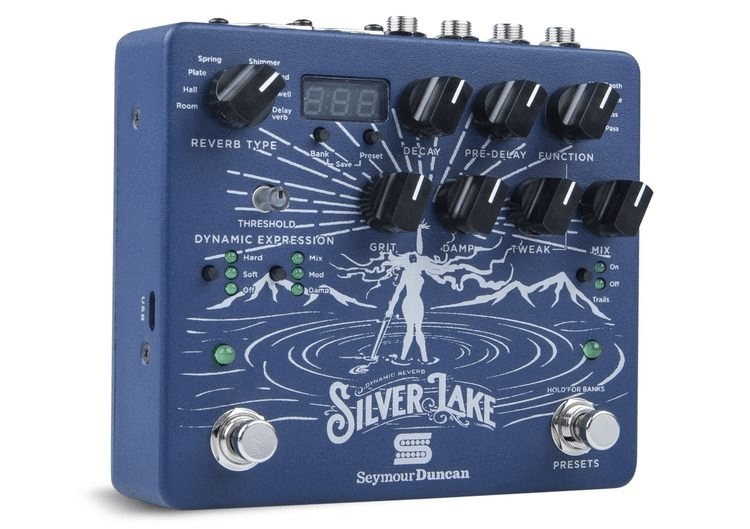
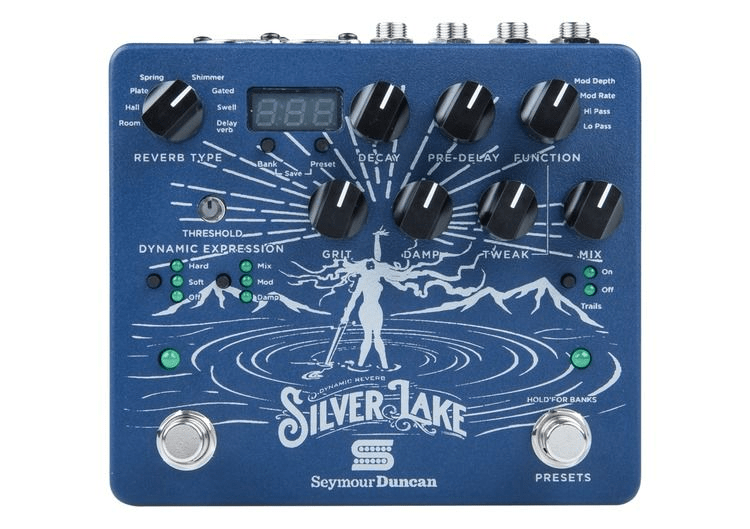
NAMM 2018: Semour Duncan Silver Lake Dynamic Reverb
At NAMM, Seymour Duncan let us take a look at their Silver Lake Dynamic Reverb pedal. If there was a award for the most improved pedal brand, then Seymour Duncan would have to take it. There is no other brand that has risen out mediocracy as well as SD. The Andromeda Delay was impressive in a time where everyone was producing some of the best digital effects that the world of guitar has ever seen. Now we get Seymour Duncan take on a top shelf Reverb. This pedal is packed full of features and designed beautifully. It's priced ($350) to compete with pedals like the RV-500 from BOSS and due to drop soon.
More Information From Sweetwater:

Fully Programmable Reverb with a World of Ambiance
With the wide variety of powerful multi reverb pedals on the market, it's refreshing to see one as intuitive and great-sounding as the Seymour Duncan Silver Lake Dynamic Reverb pedal. Onboard you'll find eight different reverb varieties, with enough tonal tweaking to create the exact sound your music needs. And thanks to Duncan's dynamic technology, you can set the reverb's character to react to the intensity of your playing. And with its MIDI capabilities, the Silver Lake is also the perfect companion for switching-based pedalboards.
Create your own space
At the heart of the Seymour Duncan Silver Lake Dynamic Reverb pedal is a powerful digital engine. It's this power that allows you to access eight separate reverb voices, including room, spring, shimmer, delay verb, and more. From there, the Grit, Damp, Mix, and Pre-Delay controls take over, tuning your delay trails to perfection. Whether you want the vintage sounds of a cranked spring tank, the natural sound of a large hall, or something completely your own, the Silver Lake Dynamic Reverb is a more than capable partner.
Dynamic Expression control
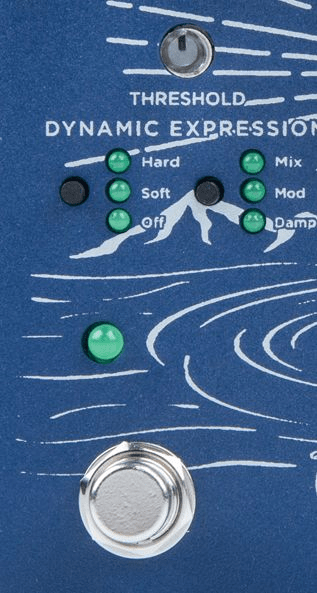
Even with all this tone shaping onboard, what sets the Silver Lake Dynamic Reverb effects pedal apart from the crowded pack available at Sweetwater is its ability to change its character based on your playing dynamics. Dynamic Expression can be tuned to affect the Mix, Mod, or Damp settings of your tone, depending on how hard you hit the strings. With this feature, you can go from a warm, modulated ambiance when lightly picked to a cavernous modulation by digging in, and it couldn't be easier to control.
Power to spare
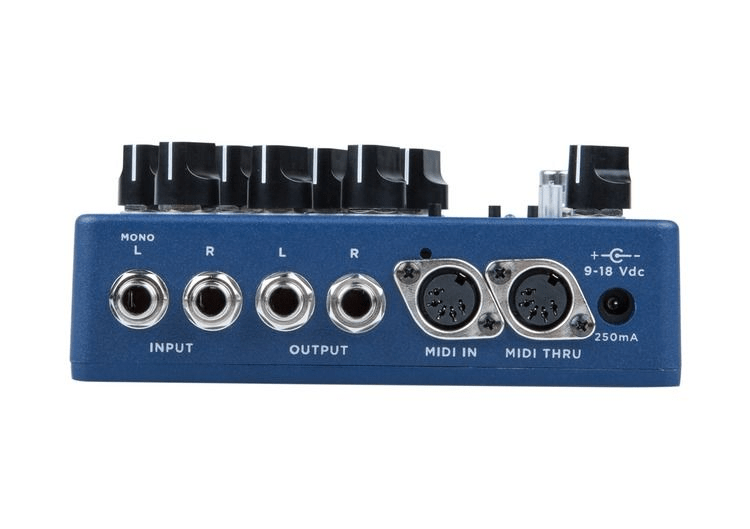
On top of its multitude of reverb types, tone-shaping abilities, and dynamic expression, the Silver Lake packs a ton of features onboard to make it extremely player friendly. The pedal's MIDI capabilities integrate the pedal into a larger rig for effortlessly accessing your presets on the fly. Stereo I/O allows you to spread your tone across multiple amplifiers. The Silver Lake's ability to run at 18 volts enhances the pedal's headroom and clarity. And a USB jack is there when it's time to keep the Silver Lake's software updated far into the future.Seymour Duncan Silver Lake Dynamic Reverb Pedal Features:
- Powerful programmable reverb pedal with a bevy of intuitive features
- Multiple voicing options, such as Grit, Damp, and Decay
- Dynamic control changes its sound depending on your playing dynamics
- MIDI switchable
- Over 100 preset locations
- Fully programmable via the top of the unit
- USB connectivity for software updates
- 8 types of reverb selectable with a rotary switch
Tuesday, January 30, 2018
Ugly Guitar Truth: Boss Katana Artist Amp
When the BOSS Katana was first announced, I wrote up my impressions of it. I liked the idea of it. It seemed like a well though out and executed design but it wasn't without it faults. I never did like the look of the amp. It was simple, but the overall look was a little bland. There was too much black on black. While I like the concept of the Kanji symbol for Katana being the amp's main design feature, it too was underwhelming and too close to familiar English letters. The price and features were too good though. BOSS had nearly every competitor beat hands down. So it's no surprise that BOSS has once again expanded their line of Katana amp with the 100 watt Artist model.
Still 100 Watts
If you are familiar with the BOSS Katana 100 Watt, then you are familiar with most of the features of the Artist. The five amp models are still there. The tone section still lets you control Lows, Mids, and Highs. You still have your Three FX: Boost/Mod, Delay FX, and Reverb. You still get Presence, and Master controls with 100/50/0.5 Watt settings. So if you were a fan of the Katana before, then you are still going to like the Artist, but is there enough to really call this an upgrade?
What's New
For starters you get a WazaCraft speaker in the Artist model. Waza is BOSS Premium line, but personally, I've never really thought that the Waza amps met the hype (or the price for that matter). The Waza was a feat for sure, but the Katana was were BOSS really hit the homerun. Having said that, is the Waza speaker an upgrade? After hearing a side by side comparison, the Artist does have the edge. However, that might be due to the cabinet construction. Another key feature is the more robust cabinet construction and the semi-open back cab. My money is on the shape and size of the cab having more to do in the change in sound than the speaker, but that's just my two cents. Other than that, the Artist gives you Cabinet Resonance and Line Out Air Feel functions.
Is It Worth It?
So, right now the Katana is priced at $600. The 2x12 100 watt Katana is priced at $500. You're getting one less speaker for 100 more dollars. While this seems like a bum deal at first, there is a fair amount of value for your money. The cabinet alone is a huge improvement. The Waza speaker may help as well. The Cabinet Resonance and Line Out Air Feel could help breathe a little life into you signal. The overall look of the amp is much improved in my opinion. Will I buy a Katana Artist? Personally? I'd love to see the head version, but I love what they done. BOSS has done an impressive job topping their already impressive line of Katana Amps.
Still 100 Watts
If you are familiar with the BOSS Katana 100 Watt, then you are familiar with most of the features of the Artist. The five amp models are still there. The tone section still lets you control Lows, Mids, and Highs. You still have your Three FX: Boost/Mod, Delay FX, and Reverb. You still get Presence, and Master controls with 100/50/0.5 Watt settings. So if you were a fan of the Katana before, then you are still going to like the Artist, but is there enough to really call this an upgrade?
What's New
For starters you get a WazaCraft speaker in the Artist model. Waza is BOSS Premium line, but personally, I've never really thought that the Waza amps met the hype (or the price for that matter). The Waza was a feat for sure, but the Katana was were BOSS really hit the homerun. Having said that, is the Waza speaker an upgrade? After hearing a side by side comparison, the Artist does have the edge. However, that might be due to the cabinet construction. Another key feature is the more robust cabinet construction and the semi-open back cab. My money is on the shape and size of the cab having more to do in the change in sound than the speaker, but that's just my two cents. Other than that, the Artist gives you Cabinet Resonance and Line Out Air Feel functions.
Is It Worth It?
So, right now the Katana is priced at $600. The 2x12 100 watt Katana is priced at $500. You're getting one less speaker for 100 more dollars. While this seems like a bum deal at first, there is a fair amount of value for your money. The cabinet alone is a huge improvement. The Waza speaker may help as well. The Cabinet Resonance and Line Out Air Feel could help breathe a little life into you signal. The overall look of the amp is much improved in my opinion. Will I buy a Katana Artist? Personally? I'd love to see the head version, but I love what they done. BOSS has done an impressive job topping their already impressive line of Katana Amps.
Ugly Guitar Truth: Fender Blues Jr Mk IV
Just ahead of NAMM Fender announced that they were updating four amps in their current line. This didn't really peak my interest until I heard that the Blues Jr. was one of those amps. I have used a Blues Jr. for many years. To me, it is almost a right of passage. This was the amp at the music store that you sampled all of your pedals through. It was the amp that you hoped to upgrade to from your cheesy starter amp. Even by many professionals, this amp is considered a valuable tool. It is the 'everyman's amp' that has the iconic Fender sound. It was, what many considered, the perfect pedal amp. Now, Fender has gone and changed that.
What They've Changed
The overall look of the amp has changed very little. I believe the backplate is now black and the knobs are white. Other than that, the two amps look identical. That is until you look at the speaker. Gone is the Eminence for favor of a Celestion A-type speaker. They've also fiddled with some things inside the amp as well. While a part for part breakdown is yet unknown, the tone-shaping and reverb are notably altered from the Mk III.
For Better or Worse
Have they improved upon a classic or messed with a good thing? Well, at this point it is a little hard to tell. They've only been available for a few days and hands on testing is limited. What I can say is that a few Key features have been changed. The spikey high end that many Fender are known to have is now rounded out. The amps presence is still there, but the high-mids that seem to rattle around in you noggin are tamed to tolerable levels. The low-end might be the measurable change though. While the Mk III was know for its defined low-end. The Mk IV has made the low-end its trademark. The Mk IV sounds much fuller when the lows are pushed. Side by side the Mk IV out shines the Mk III. Making the Mk III sound thin. The reverb is also a point of noticeable change. Despite the fact that many guitarist can conjure a sound upon hearing "Fender reverb", Fender has changed it in favor of a darker, more controlled spring.
Other Notes
While some might look at these changes as messy with a good thing, many of the changes are simply keeping up with times. Obviously, older players will still seek out that original Fender sound, but younger players desire an amp with more modern features. This line of amps is still, for the most part, a working man's amp. Pro Jr.s, Blues Jr.s, Deluxes, and Devilles, are staples of backlines and bar-stages everywhere. While I think that the Blues Jr has lost a lot of what makes it a Fender, the changes have made a little more of versatile amp.
While I wouldn't call this a Marshall-y sounding amp. Fender has made the Blues Jr more Marshall-y. Before, I would use a Blues Jr to act as the platform for my pedals. The Mk IV makes a decent sound all on its on. The breakup and overdrive/distortion are much more pleasing and usable. I can see where they might have taken bits of the Bluesbreaker amps and transplanted them into the Blues Jr. While this might make for a better overall amp, it may change the way we view and use a Blues Jr. This all sound pretty flattering, but imagine if Vox made their AC15 sound a little more like a Mesa Boogie. I know that is a dumb "what if", but what would you do if you wanted an Vox AC15 sound, but they'd changed the sound to some high-gain scooped mids nonsense. You'd have to find an older used version, right. Well, that probably our future. Our favorite pedal platform is now a thing of the past (and craigslist).
What They've Changed
The overall look of the amp has changed very little. I believe the backplate is now black and the knobs are white. Other than that, the two amps look identical. That is until you look at the speaker. Gone is the Eminence for favor of a Celestion A-type speaker. They've also fiddled with some things inside the amp as well. While a part for part breakdown is yet unknown, the tone-shaping and reverb are notably altered from the Mk III.
For Better or Worse
Have they improved upon a classic or messed with a good thing? Well, at this point it is a little hard to tell. They've only been available for a few days and hands on testing is limited. What I can say is that a few Key features have been changed. The spikey high end that many Fender are known to have is now rounded out. The amps presence is still there, but the high-mids that seem to rattle around in you noggin are tamed to tolerable levels. The low-end might be the measurable change though. While the Mk III was know for its defined low-end. The Mk IV has made the low-end its trademark. The Mk IV sounds much fuller when the lows are pushed. Side by side the Mk IV out shines the Mk III. Making the Mk III sound thin. The reverb is also a point of noticeable change. Despite the fact that many guitarist can conjure a sound upon hearing "Fender reverb", Fender has changed it in favor of a darker, more controlled spring.
Other Notes
While some might look at these changes as messy with a good thing, many of the changes are simply keeping up with times. Obviously, older players will still seek out that original Fender sound, but younger players desire an amp with more modern features. This line of amps is still, for the most part, a working man's amp. Pro Jr.s, Blues Jr.s, Deluxes, and Devilles, are staples of backlines and bar-stages everywhere. While I think that the Blues Jr has lost a lot of what makes it a Fender, the changes have made a little more of versatile amp.
While I wouldn't call this a Marshall-y sounding amp. Fender has made the Blues Jr more Marshall-y. Before, I would use a Blues Jr to act as the platform for my pedals. The Mk IV makes a decent sound all on its on. The breakup and overdrive/distortion are much more pleasing and usable. I can see where they might have taken bits of the Bluesbreaker amps and transplanted them into the Blues Jr. While this might make for a better overall amp, it may change the way we view and use a Blues Jr. This all sound pretty flattering, but imagine if Vox made their AC15 sound a little more like a Mesa Boogie. I know that is a dumb "what if", but what would you do if you wanted an Vox AC15 sound, but they'd changed the sound to some high-gain scooped mids nonsense. You'd have to find an older used version, right. Well, that probably our future. Our favorite pedal platform is now a thing of the past (and craigslist).
Labels:
Blues Jr 4,
Blues jr IV,
Blues Jr.,
Fender,
Fender Tone,
Mk IV,
New Gear,
Pedal Platform,
Tube Amp,
Ugly Guitar Truth
NAMM 2018
NAMM 2018 is finished and there is ton of new stuff that is out there. There is still a load of stuff that is yet to be released. Digitech was a big hold out this year. They didn't show us anything new, but they have promised much more stuff later this year. Several other companies showed some pretty exciting working prototypes, so we still have a lot to look forward to in 2018.
There is so much stuff out there that I can't wait to dive into. Milkman came out with a pedal based amp as did Victory. Vox expanded their MV series to include a 150 watt head. Line6 gave the HX multi effect pedal. There are more new guitars from major bands than I know what to do with. Marshall showed us the Origin series. I'm really looking forward to taking a much closer look at a lot of the stuff that has been announced as well as the stuff the I just mentioned.
NAMM is a super busy time, and I've been trying to cover most of the stuff that I've found interesting, but if there is something that you've seen from NAMM and I haven't mentioned it, then let me know in the comments. I'll try to check it out and be sure to let you know what I think.
There is so much stuff out there that I can't wait to dive into. Milkman came out with a pedal based amp as did Victory. Vox expanded their MV series to include a 150 watt head. Line6 gave the HX multi effect pedal. There are more new guitars from major bands than I know what to do with. Marshall showed us the Origin series. I'm really looking forward to taking a much closer look at a lot of the stuff that has been announced as well as the stuff the I just mentioned.
NAMM is a super busy time, and I've been trying to cover most of the stuff that I've found interesting, but if there is something that you've seen from NAMM and I haven't mentioned it, then let me know in the comments. I'll try to check it out and be sure to let you know what I think.
Saturday, January 27, 2018
NAMM 2018: MXR Sugar Drive Overdrive Pedal
MXR make some of the most iconic pedals on the market. I was excited to hear that this year at NAMM they've added several pedals to the line. Addmittedly, the pedal I most excited for is the MXR Sugar Drive. I'm a sucker for a transparent overdrive and this one seem to fit that description to a tee. In fact, several times, the guys at the MXR booth stop just short of calling it a Klone clone by name. So, if you like your pedals tiny and you are also a fan of MXR, then this is right up your ally. I would be remiss if I didn't mention that there are some other pedals strikingly similar to the MXR (Tone City Bad Horse) but the MXR does have a bypass-able buffer, so there is that.
More Information:
This year, MXR is releasing its own take—dubbed the Sugar Drive—on a rare, beloved circuit from the '90s. Packed into a pedalboard-friendly mini chassis, the pedal provides a wide range of tones, from driving boost to lush overdrive.
The pedal's interface is clean, with only three knob controls—Tone, Drive, and Volume—and an on/off footswitch on its face. Despite its simplistic aesthetic, the pedal's finely tuned circuitry is a bit more dynamic than it appears.
Instead of a Drive knob that simply increases the pedal's intensity, it actually grabs your clean, unaffected signal and blends it with the overdrive as you turn the knob. Then, the pedal's "Charge Pump" increases headroom by increasing the operating voltage. This makes for a deeper, more progressive move from clean tone to affected dirty tone and allows your sound to open up more naturally.
On the side of the chassis, you'll find a selectable switch and corresponding LED indicator for choosing between true bypass or MXR's buffered bypass.
More Information:
This year, MXR is releasing its own take—dubbed the Sugar Drive—on a rare, beloved circuit from the '90s. Packed into a pedalboard-friendly mini chassis, the pedal provides a wide range of tones, from driving boost to lush overdrive.
The pedal's interface is clean, with only three knob controls—Tone, Drive, and Volume—and an on/off footswitch on its face. Despite its simplistic aesthetic, the pedal's finely tuned circuitry is a bit more dynamic than it appears.
Instead of a Drive knob that simply increases the pedal's intensity, it actually grabs your clean, unaffected signal and blends it with the overdrive as you turn the knob. Then, the pedal's "Charge Pump" increases headroom by increasing the operating voltage. This makes for a deeper, more progressive move from clean tone to affected dirty tone and allows your sound to open up more naturally.
On the side of the chassis, you'll find a selectable switch and corresponding LED indicator for choosing between true bypass or MXR's buffered bypass.
Labels:
Clone KTR,
Klon,
Klone,
Micro Pedal,
MXR,
NAMM 2018,
New Gear,
Overdrive,
Sugar Drive,
Transparent Overdrive,
Ugly Guitar Truth
NAMM:2018: Fender Level Set Buffer Pedal
Buffer pedal tend to be small little boxes that get little attention on your board if you even have one on your board. However, Fender decided that their Buffer, in the recently release line of effects pedals, needed a couple of knobs and a footswitch. This feature make it much more of utility player than plain-Jane buffer, but I guess you could make a case that its main job is to buff. Clean looks and useful features put this buffer in strong contention for the best buffer on the market. So far, we've only been able to hear it on a loud NAMM Show floor so we may have to wait to really know how this little all-arounder really stacks up.
More Information
This is a thoroughly professional pedal - both in tone and appearance - and would make a welcome addition to your pedalboard.
More Information
Buffer and Level Matching
The Fender Level Set Buffer Pedal does not create any 'sound' as such, but it does solve two important problems with guitarists' rigs:- When using long cable runs or multiple pedals, signal can be sapped, and the upper frequencies can be lost along with the natural dynamic playing response.
- When switching guitars, levels can become miss-matched and the gain levels that you have set up on your pedals and amplifiers may be suddenly incorrect.
Professional Buffer
The Level Set Buffer creates a buffered signal and features a high-frequency control to bring back those missing treble frequencies in your tone. It also has a 'load' control to match your signal perfectly.Level Set
The Level Set Buffer also has a level control to match the signal difference when switching guitars; one example is when switching from humbuckers to single coils. This level control lets you maintain your gain levels without having to make adjustments after changing guitars; ideal for musicians playing live or for guitarists who like to maintain a predictable setup.Tuner Out
The Level Set Buffer has a tuner out for an independent tuner signal. The main footswitch acts as a mute and is a very handy tool for live players, letting them tune silently or switch guitars on-the-go.Professional Features
The Level Set Buffer has a rugged and lightweight aluminum chassis with a brushed metal finish. This gives it both read-ready durability and a classy-aesthetic that can take pride-of-place on your pedalboard. The pedal is built by Fender who have a multitude of experience in amplifier design and you can be sure that this pedal will last a lifetime of gigging, rehearsing and recording.Magnetic Battery Door & Jewel Light
The jewel LED light not only looks great, it also adds a handy on-stage visual indicator of the pedal's operation. The pedal has a clever battery compartment door; it has a magnetic latch which means you can easily change the battery with no fiddly screws to worry about.This is a thoroughly professional pedal - both in tone and appearance - and would make a welcome addition to your pedalboard.
Features
- Provides a balanced tone for pedalboards, long cable runs, and solves the problem of changing guitars
- Low and hi-frequency adjustment to match your instrument and overall tone
- Load switch to adjust signal
- Main footswitch acts as a mute
- Tuner output for independent tuning
- Enables you to switch guitars and balance your settings
- Rugged anodized aluminum construction
- Classy brushed finish and jewel light
- Battery door with magnetic latching opening (no screws needed)
- Powered by 9V battery or DC
Specifications
- Effect Type: Buffer
- Controls: Output Level, Hi-Freq Trim, Load Toggle (On/Off), Mute Footswitch
- Inputs: 1 x 1/4'' Instrument
- Outputs: 1 x 1/4'' Instrument, 1 x 1/4'' Tuner Output
- Power Requirements: 9-Volt Battery or DC Negative AC Adaptor
- Power Consumption: 14mA
- Input Impedance: 1M ohm
- Output Impedance: 1k ohm
- Material: Anodized Aluminum
- Colour: Silver
Subscribe to:
Posts (Atom)